2025-11-20 カリフォルニア大学バークレー校(UCB)
<関連情報>
- https://publichealth.berkeley.edu/articles/spotlight/research/rising-seas-put-toxic-sites-at-risk
- https://www.nature.com/articles/s41467-025-65168-2
米国全土の貧困地域における海面上昇と危険地帯の洪水 Sea level rise and flooding of hazardous sites in marginalized communities across the United States
Lara J. Cushing,Yang Ju,Seigi Karasaki,Scott Kulp,Nicholas Depsky,Alique Berberian,Jessie Jaeger,Benjamin Strauss & Rachel Morello-Frosch
Nature Communications Published:20 November 2025
DOI:https://doi.org/10.1038/s41467-025-65168-2
Abstract
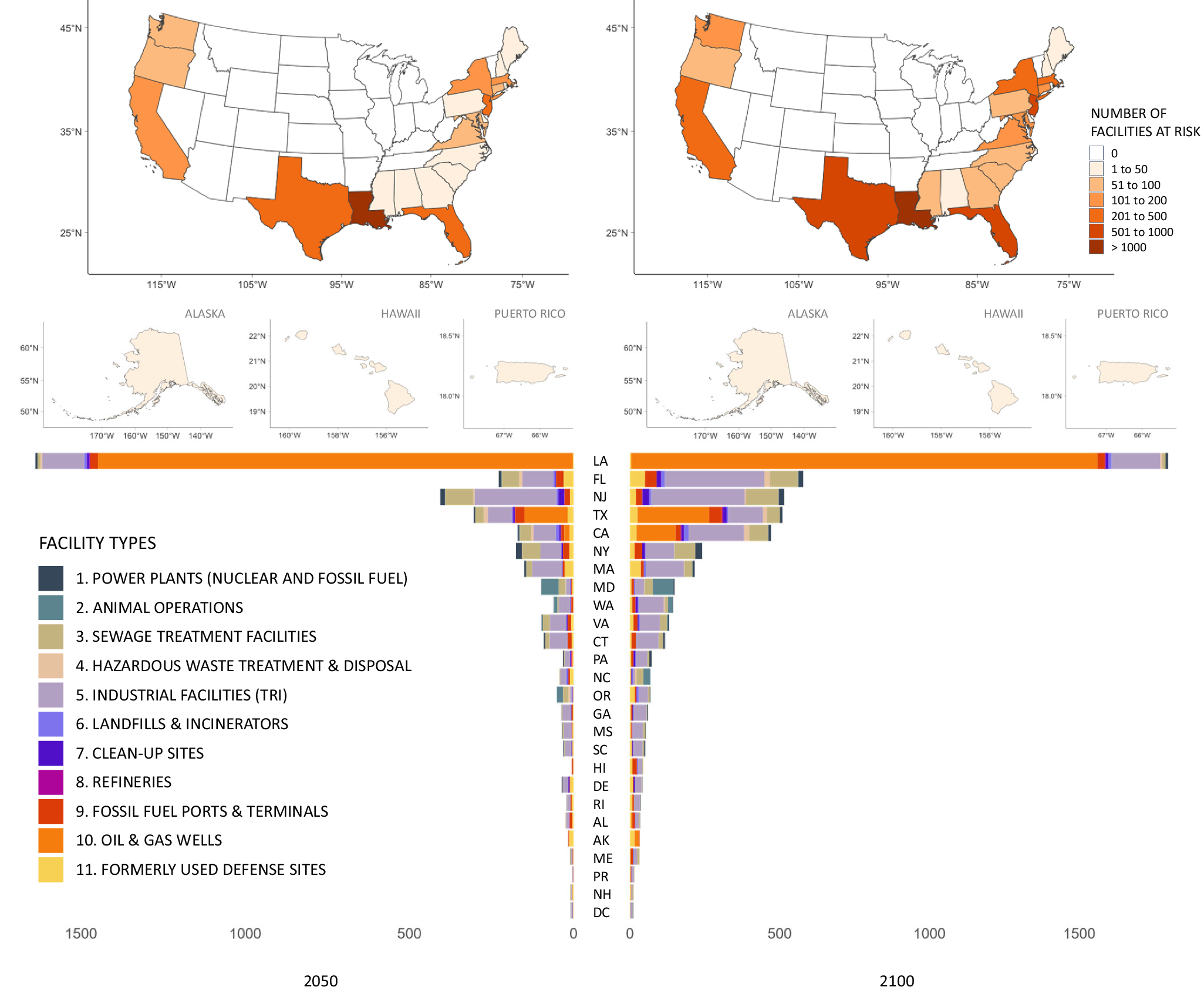
Sea level rise (SLR) increases the risk of flooding at coastal sites that use and produce hazardous substances. We assess whether socially marginalized populations in the United States are more likely to be impacted by projected SLR-related flooding of hazardous sites that could result in contaminant releases. We identify 5500 facilities at risk of a 1-in-100-year flood event by 2100 under a scenario of continued high greenhouse gas emissions, including coastal power plants, sewage treatment facilities, fossil fuel infrastructure, industrial facilities, and formerly used defense sites. Seven states (Louisiana, Florida, New Jersey, Texas, California, New York, and Massachusetts) account for nearly 80% of projected at-risk facilities. Controlling for population density and county, a one standard deviation increase in the proportion of linguistically isolated households, neighborhood residents identifying as Hispanic, households with incomes below twice the federal poverty line, households without a vehicle, non-voters, and renters is associated with 19-41% higher likelihood of having a site at risk of SLR-related flooding within 1 kilometer (odds ratios [95% confidence intervals]: 1.19 [1.09, 1.31], 1.22 [1.08, 1.37], 1.27 [1.16, 1.39], 1.35 [1.21-1.51], 1.36 [1.21, 1.53], and 1.41 [1.32, 1.52], respectively). Results elucidate the need for disaster planning, land-use decision-making, as well as mitigation strategies that address the inequitable hazards and potential health threats posed by SLR.