2025-11-14 カリフォルニア大学バークレー校(UCB)
<関連情報>
- https://news.berkeley.edu/2025/11/14/even-moderate-heat-waves-depress-sea-urchin-reproduction-along-the-pacific-coast/
- https://www.nature.com/articles/s42003-025-08829-8
配偶子形成の熱抑制はStrongylocentrotus purpuratusの幼生加入の歴史的崩壊を説明できる Thermal suppression of gametogenesis can explain historical collapses in larval recruitment in Strongylocentrotus purpuratus
Daniel K. Okamoto,Nathan B. Spindel,Maya J. Munstermann,Sam Karelitz,Brenna Collicutt,Iria Gimenez,Kate Rolheiser,Evan Cronmiller,Megan Foss,Natalie Mahara,Dan Swezey,Rachele Ferraro,Laura Rogers-Bennett & Stephen C. Schroeter
Communications Biology Published:03 November 2025
DOI:https://doi.org/10.1038/s42003-025-08829-8
Abstract
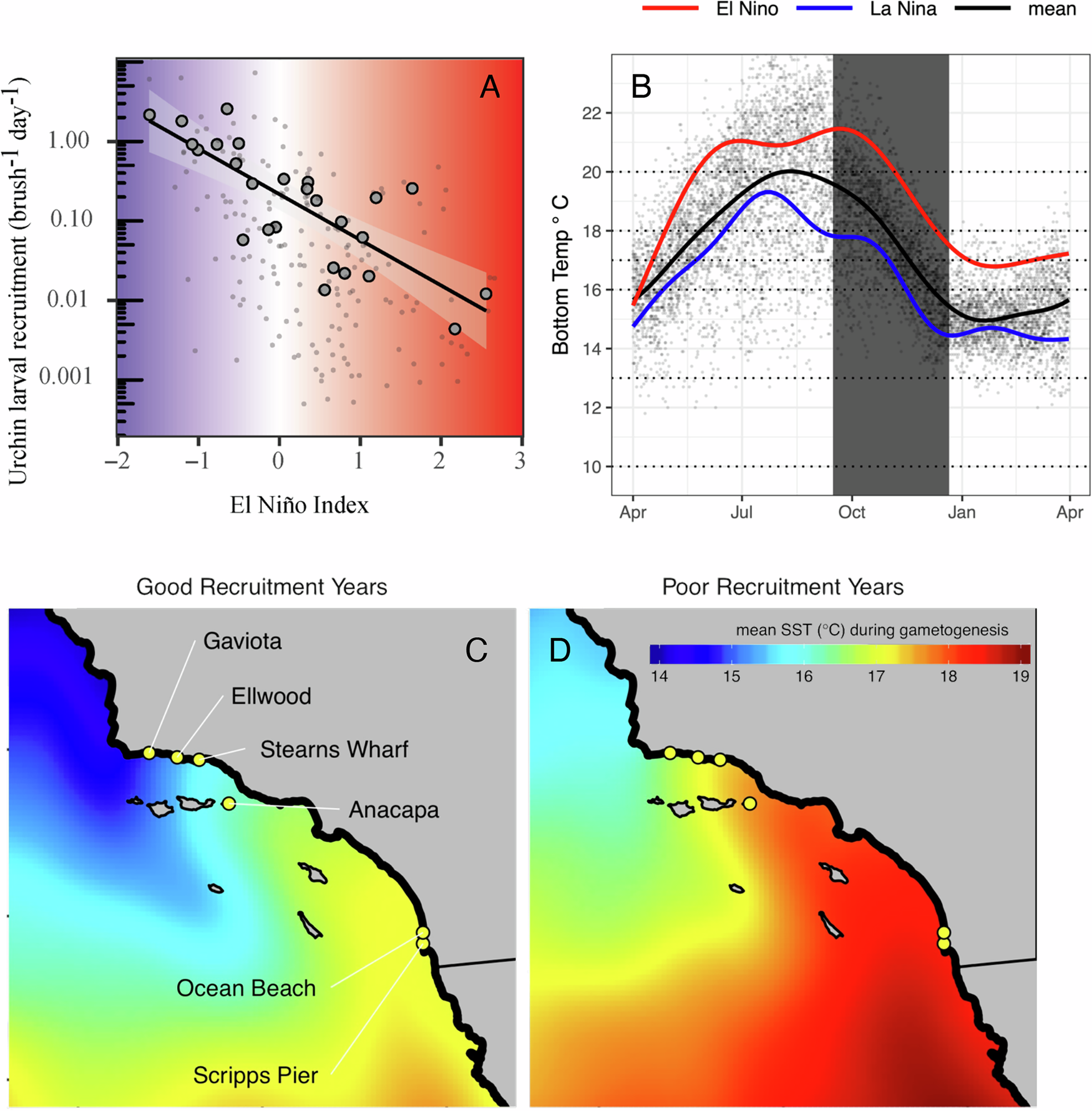
Projections for population viability under climate change are often made using estimates of thermal lethal thresholds. These estimates vary across life history stages and can be valuable for explaining or forecasting shifts in population viability. However, sublethal temperatures can also depress vital rates and shape fluctuations in the reproductive viability of populations. For example, heatwaves may suppress reproduction, causing recruitment failure before lethal temperatures are reached. Despite a growing awareness of this issue, tying sublethal effects to observed recruitment failure remains a challenge especially in marine environments. For the urchin Strongylocentrotus purpuratus, larval supply is known to decline near the southern edge of the range during marine heatwaves despite temperatures remaining below temperatures thought to limit larval survival. We experimentally show that sublethal suppression of gametogenesis by marine heatwaves can partially explain these historical collapses in recruitment. This response differs by sex: male spermatogenesis is less sensitive to elevated temperatures and marine heatwaves than females who exhibit substantial reductions in production of mature oocytes. Results were similar between animals from warmer and cooler regions of their range. Overall, we show sublethal thermal sensitivities of reproduction can narrow the thermal envelope for population viability compared to predictions from lethal limits.