2025-11-13 中国科学院(CAS)
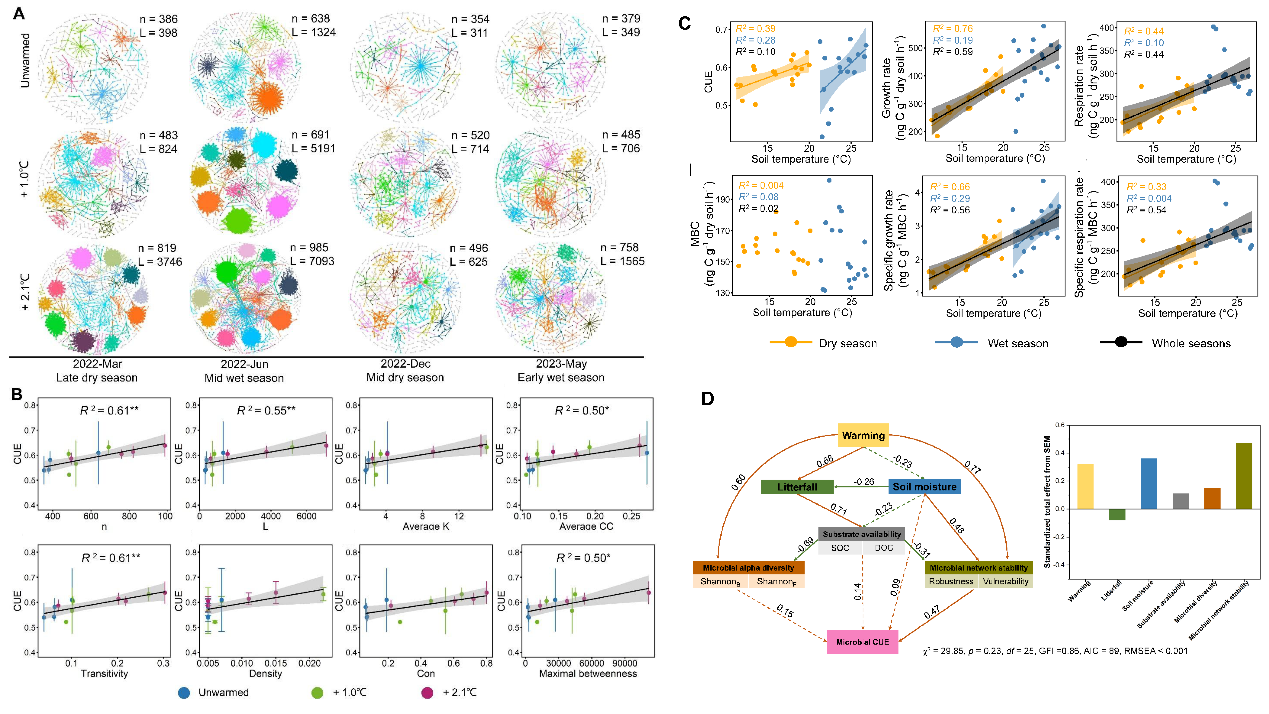
Diagram of the thermal adjustment mechanism of soil microbial carbon metabolism under long-term warming. (Image by LIU Juxiu et al)
<関連情報>
- https://english.cas.cn/newsroom/research_news/life/202511/t20251113_1115069.shtml
- https://www.science.org/doi/10.1126/sciadv.adz3747
Robust microbial interactions, not diversity, dominate metabolic thermal adjustment following decadal warming in a subtropical forest
Xujun Liu, Shu-Yi-Dan Zhou, Peter B. Reich, Zhiyang Lie, […] , and Junhua Yan
Nature Advances Published:12 Nov 2025
DOI:https://doi.org/10.1126/sciadv.adz3747
Abstract
Limited understanding of microbial metabolism under long-term warming, especially in (sub)tropical forests, impedes accurate predictions of carbon-climate feedbacks. Microbial carbon use efficiency (CUE, the partitioning of metabolized carbon for microbial growth) is crucial to the fate of soil carbon, but how it changes with warming remains unknown. Here, in contrast to the often hypothesized negative temperature dependence of microbial CUE, we observed a positive microbial CUE-temperature relationship after a decade of modest ecosystem-level warming (+1.0° and +2.1°C) in subtropical China. The warmed microbial community shifted toward more K-strategists, and the increased network stability drove metabolic thermal adjustments. These thermal adjustments resulted in homeostasis, such that warmed soils did not differ from unwarmed (+0°C) soils in microbial respiration and growth, weakening the initially stimulated carbon decomposition. These results suggest that warming-induced soil-plant system imbalance can recover to a prewarming steady state within a few seasons, mitigating predicted increases in soil carbon losses.