2025-11-06 コロンビア大学
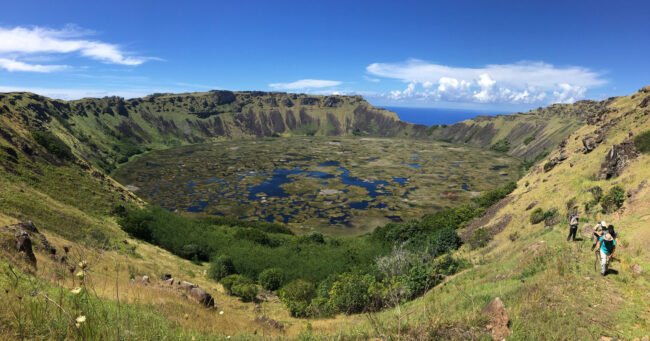
Rano Kao lake. Photo: William D’Andrea
<関連情報>
- https://news.climate.columbia.edu/2025/11/06/what-really-happened-on-easter-island-ancient-sediments-rewrite-the-ecocide-story/
- https://www.nature.com/articles/s43247-025-02801-4
巨石記念碑建設の衰退期にラパ・ヌイで長引いた干ばつ Prolonged drought on Rapa Nui during the decline of megalithic monument construction
Redmond Stein,Lorelei Curtin,Nicholas L. Balascio,Raymond S. Bradley,Dorothy M. Peteet,Rafael Rapu,Valentí Rull,Andrea Seelenfreund & William J. D’Andrea
Communications Earth & Environment Published:05 November 2025
DOI:https://doi.org/10.1038/s43247-025-02801-4
Abstract
Beginning in the 13th century, Polynesian settlers on the island of Rapa Nui engaged in megalithic monument construction, crafting hundreds of ahu platforms and moai statues from volcanic bedrock. The decline of this tradition centuries later, coincident with land-use changes and the emergence of new ritual practices on the island, has intrigued archaeologists for decades. Here, we present evidence for a transition to persistent drought conditions on Rapa Nui beginning in the mid 16th century, based on two independent reconstructions of hydrogen isotopes in rainfall inferred from hydrogen isotopes of leaf waxes preserved in wetland sediments. Consistent with observational data and model simulations, we interpret more negative hydrogen isotopes in precipitation to reflect an increase in the frequency of large storms and total rainfall amount over Rapa Nui. We show that 16th–17th century changes in human geography on Rapa Nui coincided with a sustained, multi-century decrease in annual precipitation of ~600–800 mm, which is of greater magnitude than the drying observed in recent decades.