2025-11-07 国立極地研究所,産業技術総合研究所,海洋研究開発機構,東京大学,高知大学,北海道大学,公立鳥取環境大学,山口大学,島根大学,秋田大学,東京学芸大学,法政大学,青森公立大学,総合研究大学院大学
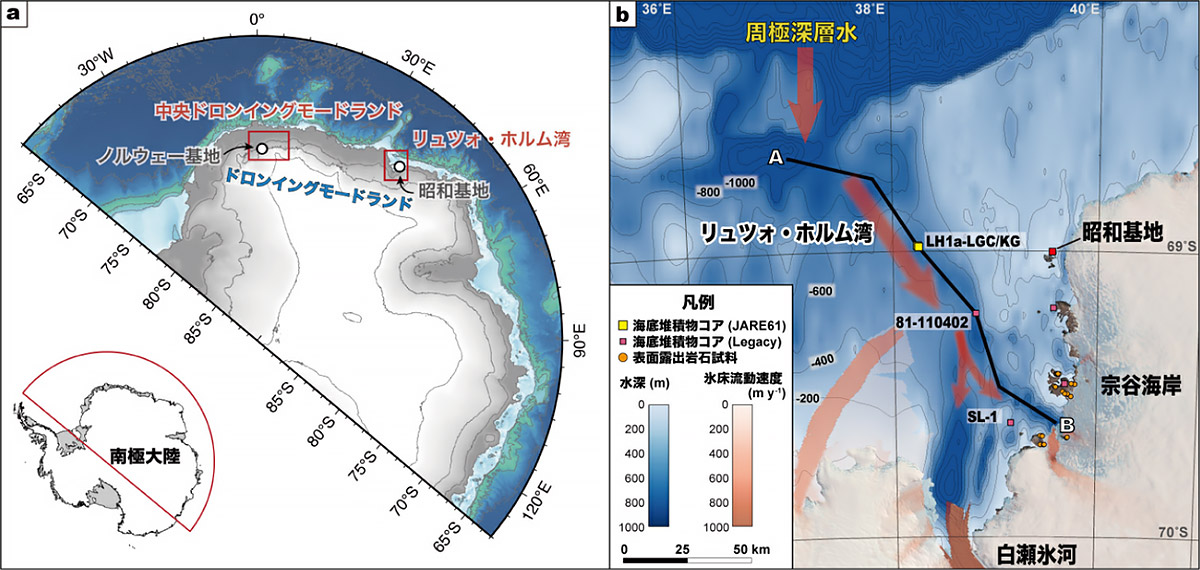
図1:(a)東南極氷床と、本研究の調査地域。(b)海底堆積物の掘削および岩石サンプルの採取ポイント。A-Bの線は図5の水温断面図に対応する。
<関連情報>
完新世における南極棚氷の崩壊は融解水放出フィードバックによって引き起こされた Antarctic ice-shelf collapse in Holocene driven by meltwater release feedbacks
Yusuke Suganuma,Takuya Itaki,Yuki Haneda,Kazuya Kusahara,Takashi Obase,Takeshige Ishiwa,Takayuki Omori,Minoru Ikehara,Robert McKay,Osamu Seki,Daisuke Hirano,Masakazu Fujii,Yuji Kato,Atsuko Amano,Yuki Tokuda,Hokuto Iwatani,Yoshiaki Suzuki,Motohiro Hirabayashi,Hiroyuki Matsuzaki,Takeyasu Yamagata,Masao Iwai,Kota Katsuki,Francisco J. Jimenez-Espejo,Hiroki Matsui,… Hideki Miura
Nature Geoscience Published:07 November 2025
DOI:https://doi.org/10.1038/s41561-025-01829-7
Abstract
Circumpolar Deep Water inflow onto Antarctica’s continental shelves is a key driver of accelerated Antarctic Ice Sheet mass loss, both presently and during the last deglaciation. However, the mechanisms driving enhanced inflow and the resultant impact on large-scale ice-sheet retreat events are still not fully understood. Here we address this topic using marine sediment cores from Lützow–Holm Bay, East Antarctica, through analyses of sedimentary beryllium isotopes and complementary proxies. These records, when compared to inland mountain outcrop records, show that ice-shelf collapse and simultaneous inland ice-sheet thinning ~9,000 years ago were associated with enhanced Circumpolar Deep Water inflow and sea-level rise. A hierarchical modelling approach that combines climate and high-resolution ocean simulations suggests that freshwater discharge from adjacent Antarctic sectors into the Southern Ocean probably enhanced the regional inflow into submarine troughs in Lützow–Holm Bay between 10,000 and 9,000 years ago. We propose a feedback loop whereby meltwater from rapidly retreating Antarctic sectors since the Last Glacial Maximum enhanced stratification and Circumpolar Deep Water incursions onto adjacent shelves. Alongside relative sea-level rise, this meltwater feedback triggers further ice-shelf instability and enhances dynamic inland ice discharge, highlighting a mechanism relevant to future Antarctic Ice Sheet changes.