2025-11-07 京都大学
<関連情報>
- https://www.kyoto-u.ac.jp/ja/research-news/2025-11-07-0
- https://www.kyoto-u.ac.jp/sites/default/files/2025-11/2511_NatComms_Kaneko_relj%20web-3e9730614f1faeffe260f85451563816.pdf
- https://www.nature.com/articles/s41467-025-64542-4
機械学習がメートル規模の実験室地震を予測 Machine learning predicts meter-scale laboratory earthquakes
Reiju Norisugi,Yoshihiro Kaneko & Bertrand Rouet-Leduc
Nature Communications Published:30 October 2025
DOI:https://doi.org/10.1038/s41467-025-64542-4
Abstract
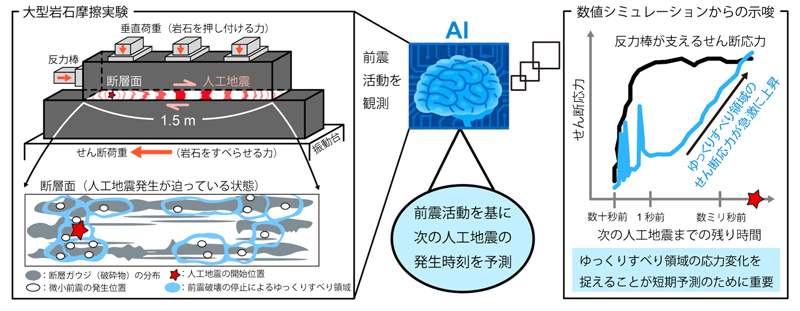
In recent years, there has been a growing interest in utilizing machine learning (ML) to investigate the predictability of shear-slip failures, known as laboratory quakes, in centimeter-scale rock-friction experiments. However, the applicability of ML to larger-scale laboratory quakes and natural earthquakes, where important timescales vary by orders of magnitude, remains uncertain. Here, we apply an advanced ML approach to meter-scale laboratory quake data, characterized by accelerating foreshock activity manifesting as increasing numbers of tiny acoustic emission events. We demonstrate that a trained ML model, using a network representation of the event catalog, can accurately predict the time-to-failure of meter-scale mainshocks, from tens of seconds to milliseconds before the upcoming main quakes. These timescales correspond to approximately decades down to weeks in the context of large earthquakes. By comparing our results with a dynamic model of shear failures that replicates the experimental data, we suggest that tracking the evolution of shear stress on creeping fault areas, rather than nominal shear stress, indirectly through the acoustic emission events, enables ML to predict both numerical and laboratory quakes. These findings provide critical insights into fault conditions that may facilitate short-term forecasting of earthquakes in nature.