2025-10-22 北京大学(PKU)
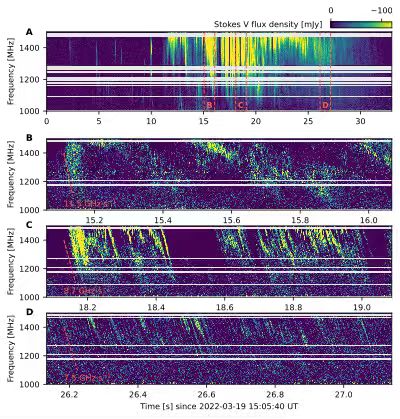
Fig. 1 Dynamic spectrum(A)and fine structures(B, C, D)of radio emission from AD Leo
<関連情報>
- https://newsen.pku.edu.cn/news_events/news/research/15264.html
- https://www.science.org/doi/10.1126/sciadv.adw6116
活動的なM型矮星から発生する超高速漂流電波バーストの起源としての星黒点 Starspots as the origin of ultrafast drifting radio bursts from an active M dwarf
Jiale Zhang, Hui Tian, Stefano Bellotti, Tianqi Cang, […] , and Menglin Huang
Science Advances Published:17 Oct 2025
DOI:https://doi.org/10.1126/sciadv.adw6116
Abstract
Detecting coherent radio bursts from nearby M dwarfs provides opportunities for exploring their magnetic activity and interaction with orbiting exoplanets. However, it remains uncertain whether the emission is related to flare-like activity similar to the Sun or magnetospheric process akin to magnetized planets. Using observations (1.0 to 1.5 gigahertz) taken by the Five-hundred-meter Aperture Spherical radio Telescope, we found a type of millisecond-scale radio bursts with exceptionally high-frequency drift rates (~8 gigahertz per second) from an active M dwarf, AD Leo. The ultrafast drift rates point to a source region with a notably low magnetic scale height (<0.15r★ ,r★ as the stellar radius), a feature not expected in a commonly assumed dipole-like global field but highly possible in localized strong-field structures, i.e., starspots. Our findings suggest that a concentrated magnetic field above starspots could be responsible for some of the most intense radio bursts from M dwarfs, supporting a solar-like electron acceleration mechanism.