2025-11-06 国立極地研究所,岐阜大学,名古屋市科学館
Web要約 の発言:
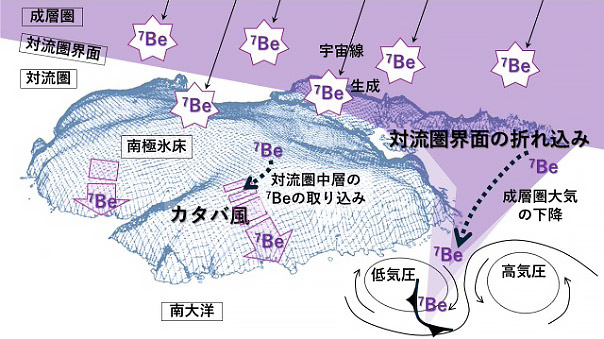
高層大気中で宇宙線により生成された7Beは、低気圧・高気圧システムに関連して発生する対流圏界面の折れ込み現象により地上付近に輸送され、また、南極大陸の斜面を吹き降りるカタバ風に取り込まれて沿岸の地上付近に輸送される。
<関連情報>
- https://www.nipr.ac.jp/info2025/20251106.html
- https://agupubs.onlinelibrary.wiley.com/doi/10.1029/2024JD043206
インド洋南極地域における地表大気中の7Be濃度の時空間変動 Spatiotemporal Variations in Surface Air 7Be Concentrations Over the Antarctic Regions of the Indian Sector
Naohiko Hirasawa, Taku Nakamura, Miyoko Miwa, Tetsuro Ojio, Kyohei Yamada, Shigeki Tasaka
Journal of Geophysical Research: Atmospheres Published: 14 October 2025
DOI:https://doi.org/10.1029/2024JD043206
Abstract
This study examined spatiotemporal variations in Beryllium-7 (7Be) concentrations measured in surface air in high-latitude regions of the Indian sector of the Southern Ocean, including two Japanese coastal stations. The sites included Syowa Station (69°00′S, 39°35′E) and site S17 (69°02′S, 40°05′E) on the coastal Antarctic ice sheet. Observations were conducted over three summers (2014/15, 2016/17, and 2017/18) as part of the Japanese Antarctic Research Expedition (JARE). Surface aerosol particles containing 7Be were collected daily or twice daily using a high-volume air sampler. 7Be concentrations ranged from below the detection limit of approximately 1–12 mBq/m3. The 7Be concentrations are higher at higher latitudes than at midlatitudes, and the effects of removal by precipitation associated with storm track may be more pronounced at midlatitudes. Fluctuations in 7Be concentrations were correlated with the passage of synoptic-scale disturbances over the sea to the west of 80°E, likely due to tropopause folding. Maximum concentrations were observed at site S17, where a stepwise increase from approximately 4 mBq/m3 (5–14 January) to approximately 8 mBq/m3 (15–28 January) was observed, likely due to repeated synoptic-scale disturbances. A diurnal pattern was observed in 7Be concentrations at site S17, with nighttime (daytime) concentrations being highest (lowest) when katabatic winds were stronger (weaker). From January 2015 to January 2017, the increase rate in 7Be concentration at site S17 was similar to the increase rate in neutron counts observed at the Neumayer III station, suggesting a reflection of the elevated 7Be production due to increased galactic cosmic rays.
Plain Language Summary
Beryllium-7 (7Be) is a cosmogenic nuclide produced in the lower stratosphere and the upper troposphere. The 7Be generation rate is highest on the poleward side of 60°S, and its half-life is approximately 53.2 days. High concentrations of 7Be in air indicate that air from the polar stratosphere has invaded the troposphere. The mechanisms that drive air transport from the stratosphere through the troposphere to the surface of the Antarctic ice sheet can be clarified by investigating atmospheric circulation of 7Be concentrations. However, removal of 7Be by precipitation should be also considered. We examined the geographical characteristics of 7Be concentrations over high latitudes in the Indian sector of the Southern Ocean, including two Japanese coastal stations. The findings showed that variations in the 7Be concentration occurred in conjunction with synoptic-scale disturbances. Atmospheric circulation systems also deposit other stratospheric materials, such as volcanic material from the troposphere, onto the AIS, which can be used as climatic markers in ice cores. Thus, the findings of this study also contribute to decoding paleoclimate atmospheric circulation patterns in ice core investigations.
Key Points
- The characteristics of measured 7Be concentrations in the Antarctic coastal region are described
- Fluctuations in 7Be concentrations are correlated with the passage of synoptic-scale disturbances, likely caused by tropopause folding
- Diurnal variation in 7Be concentrations on the coastal Antarctic ice sheet is synchronized with katabatic winds