2025-11-06 核融合科学研究所,京都大学,名古屋大学
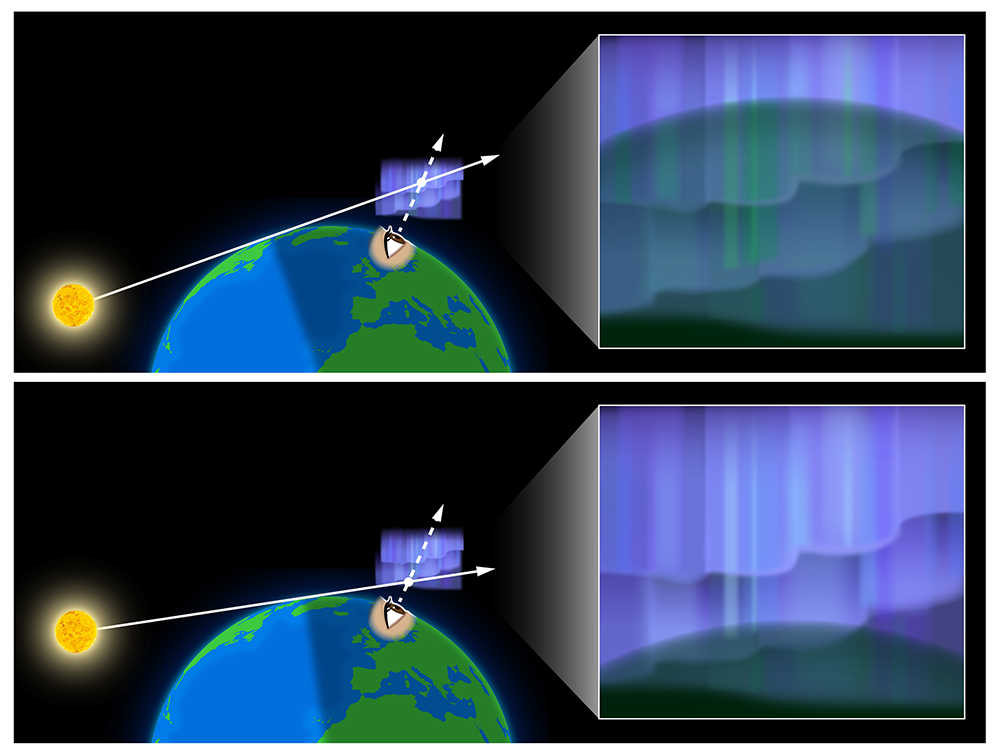
図 朝方で太陽が上がるにつれて、オーロラの太陽に照らされている部分が高高度から始まり、時間と共に、下に広がってくる様子
<関連情報>
- https://www.nifs.ac.jp/news/research/251106.html
- https://agupubs.onlinelibrary.wiley.com/doi/10.1029/2025GL118375
推定値 N+2 HySCAIによる天文薄明時の青色オーロラ共鳴散乱427.8 nm放射を用いた高度プロファイル Estimate of N+2 Altitude Profile Using Blue Auroral Resonant-Scattering 427.8 nm Emission Observed With HySCAI During Astronomical Twilight
K. Ida, M. Yoshinuma, Y. Ebihara, K. Shiokawa
Geophysical Research Letters Published: 05 November 2025
DOI:https://doi.org/10.1029/2025GL118375
Abstract
The spectrum of high-altitude blue auroral emissions was observed with HyperSpectral camera for auroral imaging (HySCAI) during morning astronomical twilight in Kiruna. Auroral resonance scattering of an N+2 1NG (0, 1) (427.8 nm) emission starts to increase from the east, and then the increase of this resonance scattering emission extends to the magnetic zenith. The volume emission rate is evaluated from the rise in resonance scattering emission (time derivative of emission intensity). The volume emission rate of N+2 (427.8 nm) reaches its maximum when the sunlight shadow height reaches 200 km, although the GLOW model predicted a peak altitude of N+2 (427.8 nm) of 120 km. The higher altitude of the resonance scattering emission peak observed with HySCAI supports the idea that N+2 is produced by the charge exchange between N2 and O+ existing at high altitudes. However, we cannot rule out another possible mechanism of upflowing N+2 ions.