2025-11-05 ペンシルベニア州立大学(PennState)
Web要約 の発言:
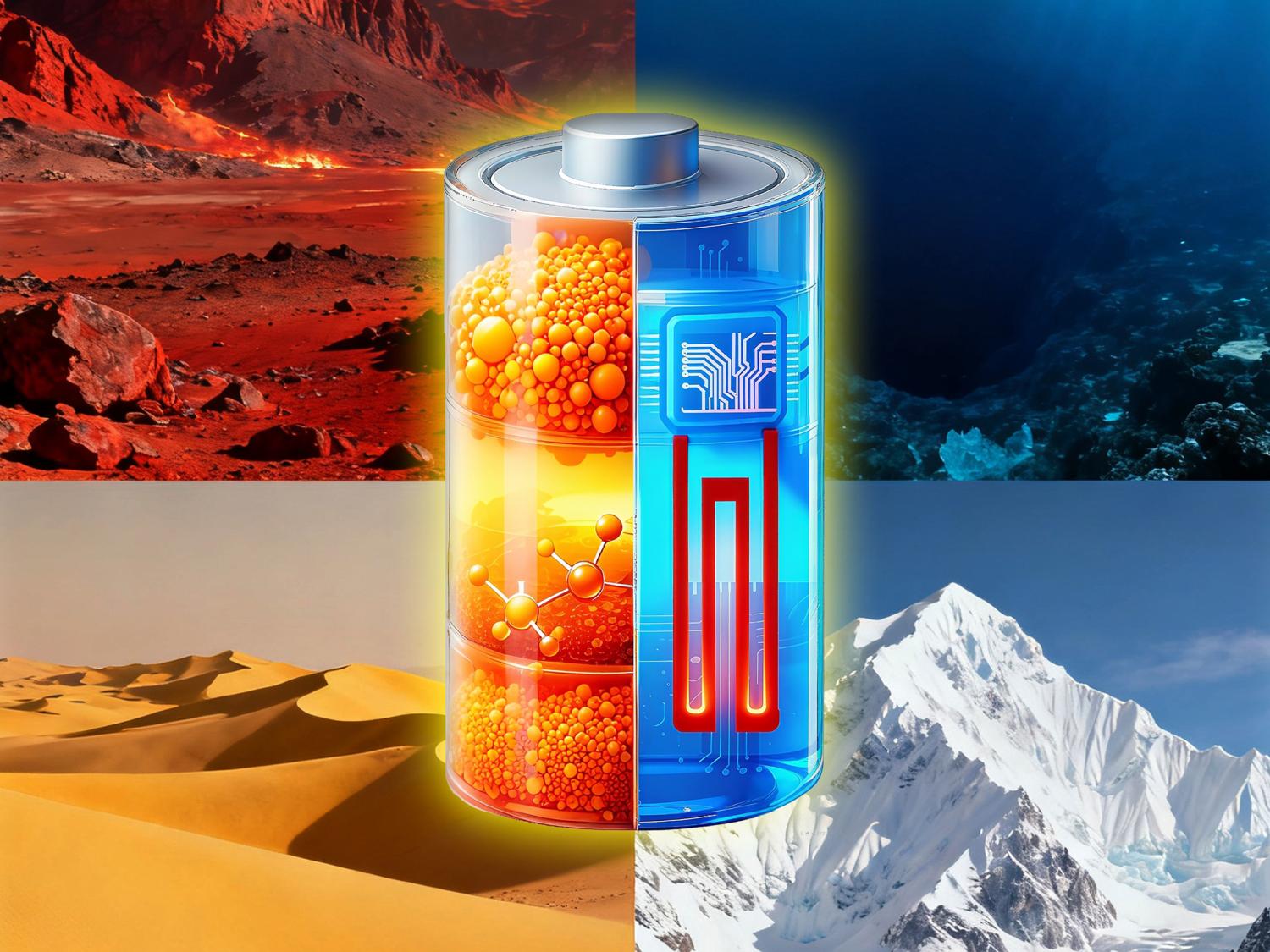
A new battery design, proposed by researchers at Penn State, could allow lithium-ion batteries to perform well in any climate by using optimized materials and an internal heating system. Credit: Illustrated by Wen-Ke Zhang/Provided by Chao-Yang Wang. All Rights Reserved.
<関連情報>
- https://www.psu.edu/news/engineering/story/proposed-all-climate-battery-design-could-unlock-stability-extreme-temps
- https://www.cell.com/joule/abstract/S2542-4351(25)00359-9
全気候対応型バッテリーエネルギー貯蔵 All-climate battery energy storage
Chao-Yang Wang ∙ Kaiqiang Qin ∙ Nitesh Gupta
Joule Published:November 5, 2025
DOI:https://doi.org/10.1016/j.joule.2025.102178
Abstract
We examine the latest developments in all-climate batteries (ACBs) that enable efficient and resilient energy storage across extreme temperature ranges, e.g., from −50oC to +60oC. A figure of merit is presented to quantify where the current state of art, the latest advances and the future targets stand in this rapidly evolving field. We review two distinctive approaches driving power and stability improvements in both low- and high-temperature environments: materials innovation (particularly electrolyte formulations) and thermal actuation. It is found that there are still two-orders-of-magnitude gaps from the ACB target of high-temperature stability by materials innovation alone and that the material-thermal synergetic approach promises to attain the dual goals of ACBs for uncompromised power and stability at both low and high temperatures. Future research should be focused on developing heat-tolerant electrolytes and electrodes that can survive in 70oC–85oC environments.