2025-10-30 カーディフ大学
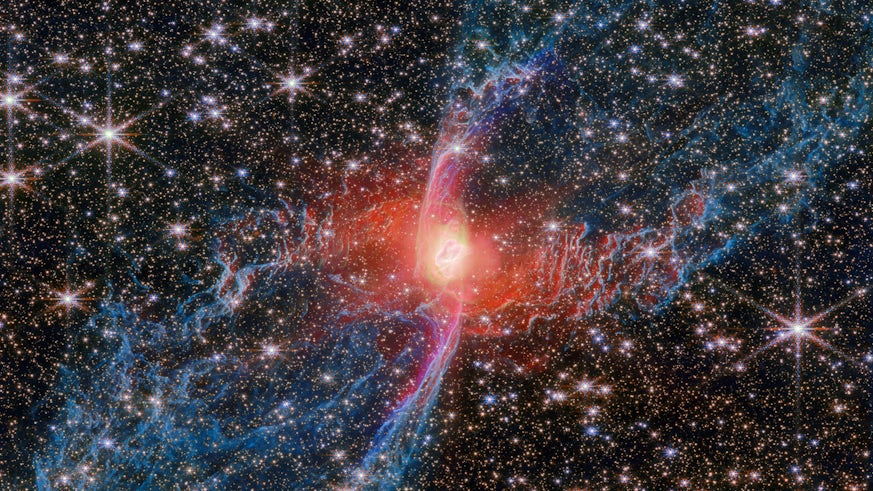 Credit: ESA/Webb, NASA & CSA, J. H. Kastner (Rochester Institute of Technology)
<関連情報>
- https://www.cardiff.ac.uk/news/view/2976070-webb-serves-up-halloween-treat-with-new-images-of-cosmic-creepy-crawly
- https://iopscience.iop.org/article/10.3847/1538-4357/ae0706
JWST/NIRCamによる双極惑星状星雲NGC 6537の画像:(赤外線)クモの正体 JWST/NIRCam Imaging of the Bipolar Planetary Nebula NGC 6537: The (Infra)red Spider, Revealed
Joel H. Kastner, Paula Moraga Baez, Bruce Balick, Rodolfo Montez Jr., Caroline Gieser, Mikako Matsuura, Jason Nordhaus, and Miguel Santander-Garcia
The Astrophysical Journal Published: 2025 October 28
DOI:10.3847/1538-4357/ae0706
Abstract
We present James Webb Space Telescope (JWST) Near-Infrared Camera (NIRCam) Brα, H2, [Fe ii], and polycyclic aromatic hydrocarbon (PAH) imaging of the molecule-rich, high-excitation bipolar planetary nebula (PN) NGC 6537 (the Red Spider), complemented by new Atacama Large Millimeter/submillimeter Array (ALMA) and Chandra X-ray Observatory (Chandra) observations and archival Hubble Space Telescope (HST) images. The resulting multiwavelength view of the Red Spider establishes the detailed lobe–torus structure of the nebula and the mass-loss history of its progenitor star. The extinction-penetrating JWST/NIRCam Brα and PAH and ALMA 3 mm continuum imaging exposes the complexity of the ionized inner nebula. JWST/NIRCam H2 imaging traces the full, ∼1.1 pc extent of the bubble-like lobes formed by fast (∼300–400 km s−1) polar outflows, while ALMA 13CO(1–0) mapping reveals a point-symmetric, slowly (∼10 km s−1) expanding equatorial torus of radius ∼ 0.13 pc. In striking contrast, the [Fe ii] image displays an extended S-shaped emission morphology that traces collisions between an active, collimated wind and slower-moving material along the lobe rims. No X-rays are detected from the nebula or its central star in deep Chandra/HRC-I imaging. However, the combined HST and JWST imaging reveals a near-IR excess at the central star indicative of emission from hot (∼1000 K) circumstellar dust. We propose that interactions between the nebular progenitor star and a close companion are responsible for the ejection of NGC 6537’s molecular torus, the formation of a circumbinary dust disk, and the launching of fast, wandering, collimated outflows that have inflated the polar lobe bubbles traced by near-IR H2 emission and are presently generating the [Fe ii]-emitting shocks.