2025-10-30 京都大学
<関連情報>
- https://www.kyoto-u.ac.jp/ja/research-news/2025-10-30
- https://www.kyoto-u.ac.jp/sites/default/files/2025-10/2510_JofForRes_Onoda_2510%20web-3c5f79acc127130b856044b2457c2c9d.pdf
- https://www.tandfonline.com/doi/full/10.1080/13416979.2025.2576384
23 の種多様性の ⾼い⾃然林における幹直径や地上部バイオマスを推定するための樹冠レベルのアロメトリー式の開発 Development of crown-based allometric equations for estimating stem diameter and above-ground biomass using UAV-LiDAR in 23 species-rich natural forests of Japan
Kyaw Kyaw Htoo,Masanori Onishi,Md. Farhadur Rahman,Ryuichi Takeshige,Kaoru Kitajima & Yusuke Onoda
Journal of Forest Research Published:28 Oct 2025
DOI:https://doi.org/10.1080/13416979.2025.2576384
ABSTRACT
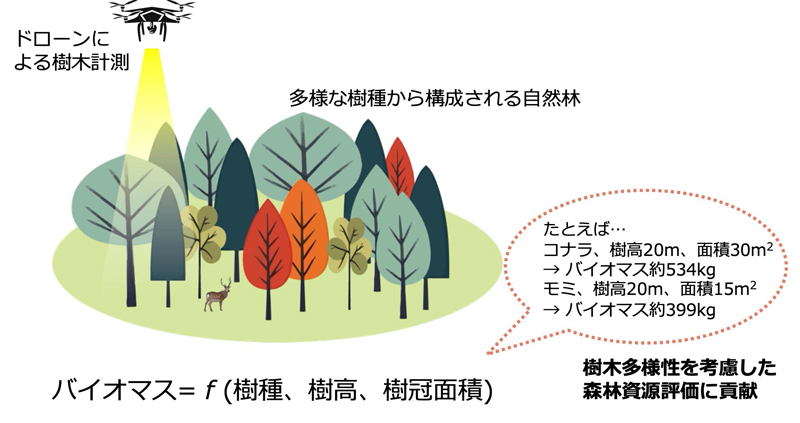
Accurate measurement of structural traits of individual trees, such as stem diameter, crown height (H), and crown area (CA), is essential for assessing forest biomass and ecosystem functions. UAV-LiDAR technology enables detailed measurement of these traits over extensive areas for estimation of above-ground biomass (AGB). However, most previous studies using UAV-LiDAR have been conducted on planted conifer trees, with limited applications to natural forest trees. In this study, we measured H and CA for 149 canopy species encompassing 4,326 individuals across 23 natural forests in Japan, using UAV-LiDAR. We developed general, functional-type-specific, and species-specific allometric models to estimate stem diameter at breast height (DBH) and AGB based on H and CA. The models incorporating H and CA provided a substantial explanation of DBH (69%) and AGB (72%) variations across different forests and regions. The integration of functional types or species-specific information enhanced R2 by 9–12% for DBH and by 7–11% for AGB, thereby allowing the models to explain up to 81% of the variations in DBH and 83% in AGB. UAV-detectable trees accounted for more than two-thirds of the total AGB across various forest types, underscoring the reliability of UAV surveys in capturing standing AGB. The crown-based allometric models developed in this study may be useful for estimating DBH and AGB of canopy trees in multiple types of natural forests.