
2025-10-27 中国科学院(CAS)
<関連情報>
- https://english.cas.cn/newsroom/cas_media/202510/t20251027_1094854.shtml
- https://www.nature.com/articles/s41598-025-20229-w
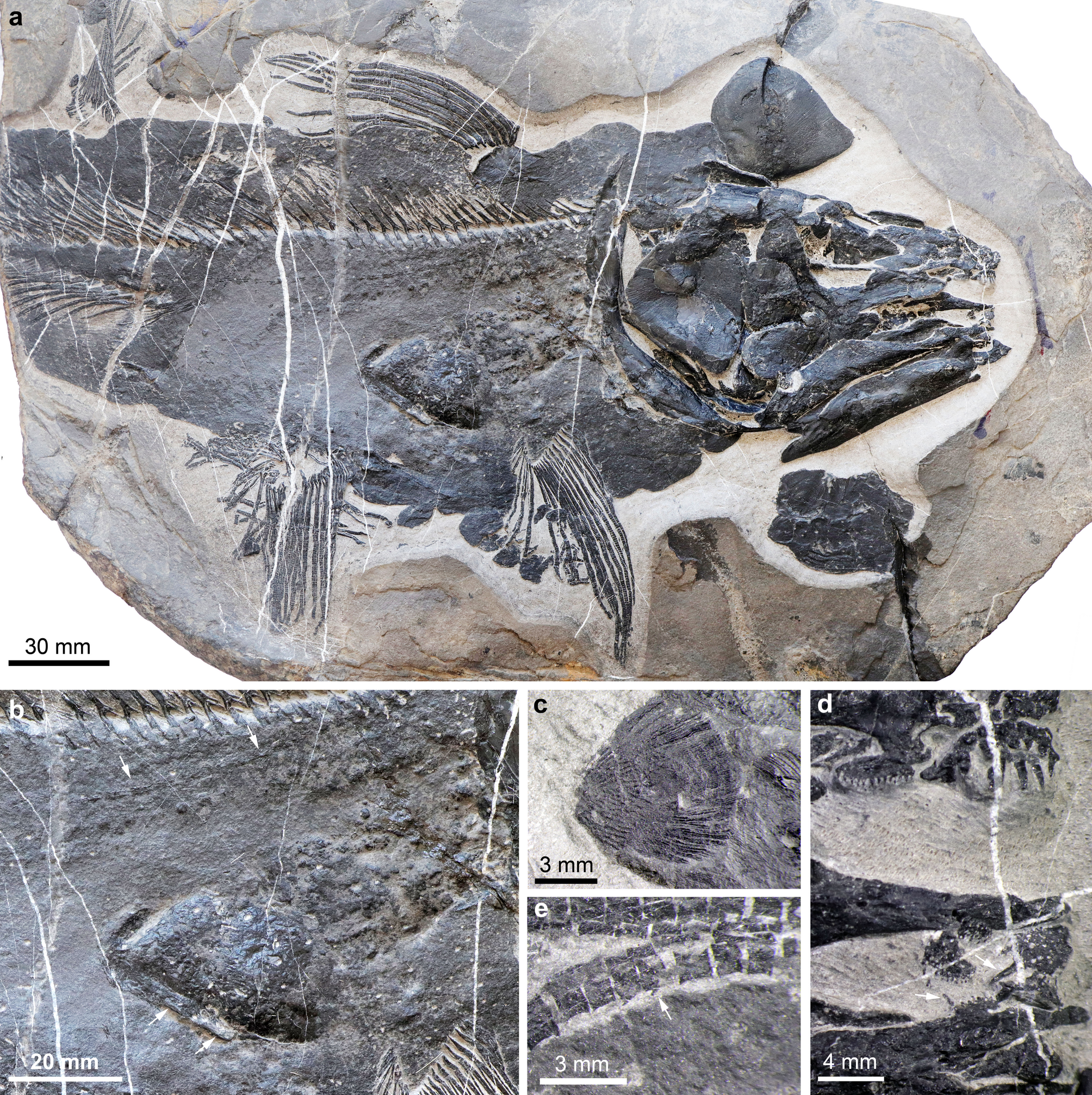
中国安徽省の三畳紀前期から発見された新種のシーラカンス(アクティニスティア、肉鰭綱) A new coelacanth (Actinistia, Sarcopterygii) from the Early Triassic of Anhui, China
Qing-Hua Dai,Guang-Hui Xu,Feng-Ting Tan,Zhi-Wei Yuan,Cheng-Kai Sun,Jun-ling Liao,Bing-He Geng & Hai-Jun Song
Scientific Reports Published:17 October 2025
DOI:https://doi.org/10.1038/s41598-025-20229-w
Abstract
Coelacanths (e.g., Latimeria) are a curious group of sarcopterygian fishes that survive over hundreds of millions of years and are important in evolutionary biology. In the Early Triassic, coelacanths reached their peak of taxonomic diversity but had only patchy fossil record in Asia. Here, we report the discovery of a new species of the coelacanth genus Whiteia on the basis of two specimens from the late Smithian (~ 249 Ma) marine deposits exposed in eastern Anhui, China. The discovery considerably extends the spatial range of Whiteia in the Early Triassic, and documents the oldest species of the genus in Asia, predating the previously oldest record of whiteiids in this continent by nine million years. The new coelacanth with an estimated total length of at least 420 mm, larger than most of other coelacanths (except Rebellatrix) at its age, represents the largest whiteiid named so far from the Early Triassic and provides an important addition for our understanding the evolution of this major Triassic clade of coelacanths.


