2025-10-10 中国科学院(CAS)
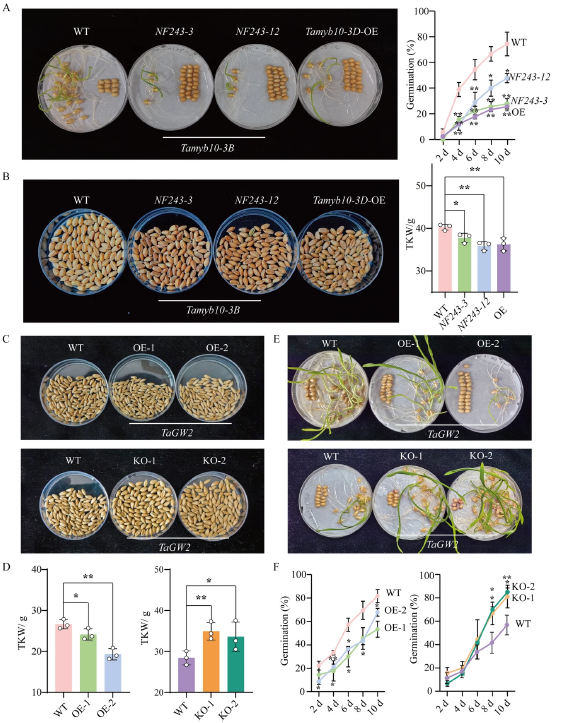
Tamyb10 and TaGW2 affect both seed dormancy and seed size in wheat (Image by IGDB)
<関連情報>
- https://english.cas.cn/newsroom/research_news/life/202510/t20251016_1089548.shtml
- https://genomebiology.biomedcentral.com/articles/10.1186/s13059-025-03770-9
小麦の種子の大きさと休眠性に関連する対立遺伝子に対する選択の拮抗的影響 Antagonistic effects of selection on alleles associated with seed size and seed dormancy in wheat
Feilong Guo,Changbin Yin,Tian Li,Sitong Liu,Jiayu Dong,Hao Jiang,Yu Fang,Jun Wei,Yi Han,Yu Li,Hong Cao,Yuting Ning,Galal Khamis,Xin Deng,Ke Wang,Jirui Wang,Cuijun Zhang,Fei Lu & Yongxiu Liu
Genome Biology Published:25 September 2025
DOI:https://doi.org/10.1186/s13059-025-03770-9
Abstract
Background
Seed dormancy and size are two crucial traits influencing crop yield, and they have undergone strong selection during cereal domestication and improvement. However, the genetic basis underlying the antagonistic effects between seed dormancy and seed size remains poorly understood.
Results
Based on genome-wide association study, we perform a comprehensive comparative analysis of 545 global wheat accessions to dissect the genetic architecture of these two traits during wheat improvement. We detect a strong negative correlation between the accumulation of favorable alleles for seed dormancy and the accumulation of favorable alleles for seed size. At the wheat genome level, a set of SNPs harboring antagonistic alleles explain up to 26.56% and 47.21% of the phenotypic variation for seed dormancy and seed size, respectively. In contrast, a set of SNPs with synergistic alleles account for only 0.54% and 1.12% of the variation in both traits. During wheat breeding improvement, favorable alleles associated with increased seed size are preferentially selected, resulting in a compromise in seed dormancy. Under different climate conditions, the frequencies of haplotypes of the pleiotropic genes with antagonistic effects and synergistic loci collectively shape wheat diversity through balancing seed dormancy and seed size.
Conclusions
Our findings reveal the genetic architecture underlying the observed weakening of seed dormancy as seed size increases during wheat improvement, enabling further genome-informed cultivar breeding to balance and improve seed dormancy and seed size traits.