
2025-10-17 愛媛大学
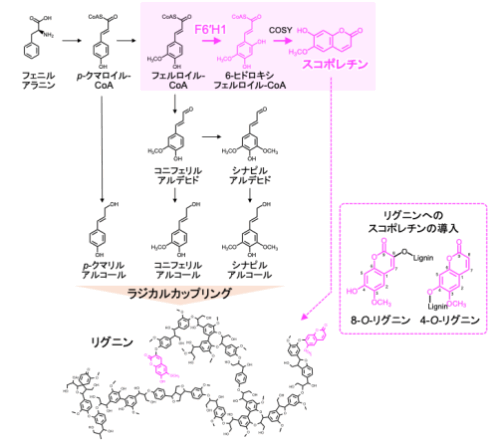
図1リグニン前駆物質の生合成経路と F6’H1 高発現によるリグニンへのスコポレチンの導入
<関連情報>
- https://www.ehime-u.ac.jp/data_relese/pr_20251017_agr/
- https://www.ehime-u.ac.jp/wp-content/uploads/2025/10/pr_20251017_agr.pdf
- https://onlinelibrary.wiley.com/doi/10.1111/pbi.70390
フェルロイルCoA 6′-ヒドロキシラーゼ遺伝子高発現により発色団を導入したポプラリグニンのフォトルミネッセンス特性 Photoluminescence Properties of Lignin With a Genetically Introduced Luminophore in a Transgenic Hybrid Aspen That Overproduces Feruloyl-CoA 6′-Hydroxylase
Masatsugu Takada, Shota Horinouchi, Naning Wang, Mikiko Uesugi, Shinya Kajita
Plant Biotechnology Journal Published: 03 October 2025
DOI:https://doi.org/10.1111/pbi.70390
ABSTRACT
Lignin, a major cell-wall component of woody biomass, exhibits photoluminescent (PL) properties. Controlling the intensity and colour of the PL is essential for producing lignin-based value-added materials. Herein, we modify the PL properties of lignin via genetic engineering of novel luminophore structures. Feruloyl-CoA 6′-hydroxylase (F6′H1) is a 2-oxoglutarate-dependent dioxygenase that catalyses the conversion of feruloyl-CoA, an intermediate of the biosynthesis pathway of monolignol, into 6′-hydroxyferuloyl-CoA, the precursor of scopoletin. To modify the lignin PL properties, the F6′H1 gene (F6′H1) from Arabidopsis thaliana is overexpressed in the hybrid aspen (Populus tremula × tremuloides T89), incorporating scopoletin into the lignin molecule. Cellulolytic enzyme lignin (CEL) was isolated from transgenic aspens with different overexpression levels of F6′H1 and evaluated for its PL properties. In N.N-dimethylformamide solution, CEL from the F6′H1-overexpressed aspen emitted clear PL with higher intensity and a longer wavelength than the wild-type CEL. Size exclusion chromatography revealed a wide molar mass distribution of the chromophore. Interestingly, the PL of the CEL from the F6′H1 transgenic lines was limitedly quenched in low polar solvents and at high concentrations. The CEL from F6’H1 emitted obvious PL not only in solution but also in polymer film. Furthermore, the CEL of F6′H1 lines exhibited a reversible photodimerisation reaction characteristic of coumarins. These results suggest that genetic engineering can incorporate new luminophores such as scopoletin into lignin, thus producing value-added materials.


