2025-10-07 マサチューセッツ工科大学(MIT)
Web要約 の発言:
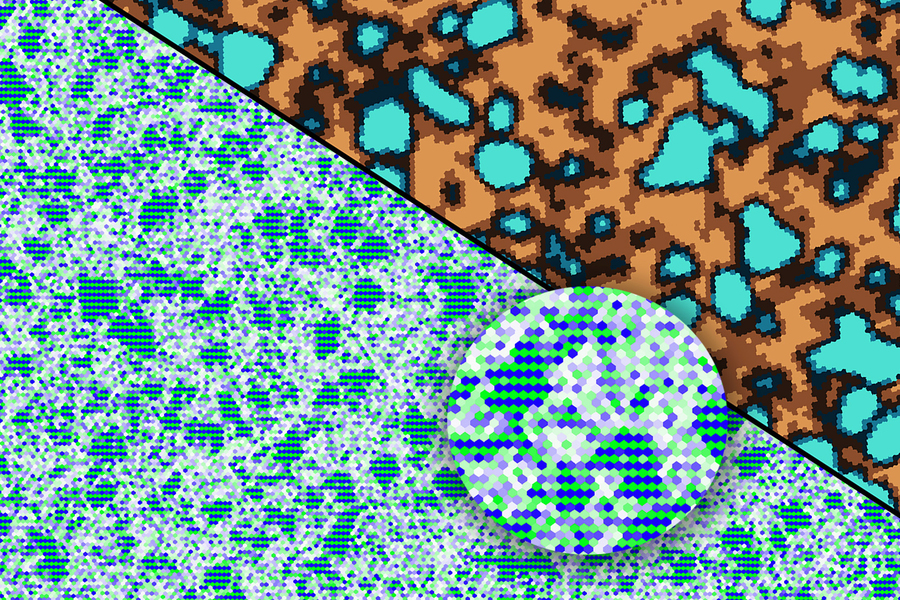
A new 3-D-printed aluminum alloy is stronger than traditional aluminum, due to a key recipe that, when printed, produces aluminum (illustrated in brown) with nanometer scale precipitates (in light blue). The precipitates are arranged in regular, nano-scale patterns (blue and green in circle inset) that impart exceptional strength to the printed alloy.
Credit: Felice Frankel
<関連情報>
- https://news.mit.edu/2025/printable-aluminum-alloy-sets-strength-records-may-enable-lighter-aircraft-parts-1007
- https://advanced.onlinelibrary.wiley.com/doi/10.1002/adma.202509507
急速凝固法によって実現した、粗大化耐性ミクロ組織を有する積層造形可能な高強度アルミニウム合金 Additively Manufacturable High-Strength Aluminum Alloys with Coarsening-Resistant Microstructures Achieved via Rapid Solidification
S. Mohadeseh Taheri-Mousavi, Michael Xu, Florian Hengsbach, Clay Houser, Zhaoxuan Ge, Benjamin Glaser, Shaolou Wei, Mirko Schaper, James M. LeBeau …
Advances Materials Published: 02 October 2025
DOI:https://doi.org/10.1002/adma.202509507
Abstract
Additively manufactured aluminum (Al) alloys with high strength have broad industrial applications. Strength promotion necessitates a high-volume fraction of small, closely spaced precipitates to effectively impede dislocation motion. Here, it is shown that for certain compositions in the Al-Er-Zr-Y-Yb-Ni alloy class, L12-Al3M phases, the primary strength contributor, can initially precipitate as submicron-scale (≈100 nm) metastable ternary phases under the rapid solidification of powder bed additive manufacturing; yet the subsequent coarsening-resistant L12-Al3M phases that precipitate during heat treatment remain at the nanometer scale, imparting high strength. A candidate alloy is designed using hybrid calculation of phase diagrams (CALPHAD)-based integrated computational materials engineering (ICME) and Bayesian optimization algorithms. Powder is manufactured for this alloy and is additively manufactured into crack-free macroscale specimens with a strength that is five-fold that of the equivalent cast alloy and comparable to wrought Al 7075. After aging at 400 °C for 8 h, the room-temperature tensile strength reaches 395 MPa, which is 50% stronger than the best-known benchmark printable Al alloy. This integrated computational-experimental workflow shows the considerable potential to exploit rapid solidification in additive manufacturing to design alloys with commercially deployable properties.