2025-10-02 北海道大学
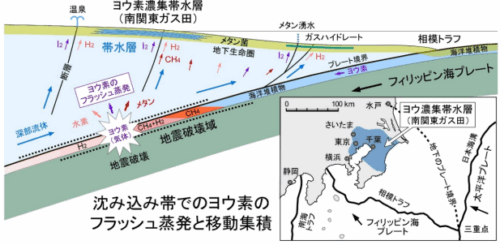
図 1.フィリッピン海プレート沈み込み帯でのヨウ素、メタン、⽔素の排出・移動・集積とヨウ素濃集帯⽔層(南関東ガス⽥)の形成。
<関連情報>
- https://www.hokudai.ac.jp/news/2025/10/post-2072.html
- https://www.hokudai.ac.jp/news/pdf/251002_pr.pdf
- https://www.sciencedirect.com/science/article/pii/S0009254125004218?via%3Dihub
Flash vaporization and migration of iodine in the oceanic plate subduction zone 海洋プレート沈み込み帯でのヨウ素のフラッシュ蒸発と移動
Noriyuki Suzuki, Jun Kameda, Miki Amo
Chemical Geology Available online: 3 September 2025
DOI:https://doi.org/10.1016/j.chemgeo.2025.123031
Highlights
- I2 in oceanic sediments subducting with the hot oceanic plate may behave as a liquid.
- I2 vaporizes and is expelled from subducted sediments during earthquake ruptures.
- I2, along with thermogenic CH4 and H2, is co-expelled from subducted sediments.
- Crustal fluids in the hot oceanic plate subduction zone are enriched in I2 and CH4.
Abstract
Crustal fluids in subduction zones, such as subsurface aquifers, submarine seeps, and gas hydrate waters, are often rich in iodine (I2) and methane (CH4). Large-scale aquifers in the Kanto subduction zone, where the Pacific Plate (PAC) and the Philippine Sea Plate (PHS) are subducting, also exhibit high concentrations of I2 and CH4. However, the origin and behavior of I2 in the subduction zone are unclear, and its coexistence with CH4 remains unresolved. To investigate this, we compiled the I2 phase diagram under high-pressure and high-temperature (P–T) conditions to predict its physicochemical properties in the subduction zone. We then applied the P–T paths of subducted PAC and PHS sediments to the I2 phase diagram. Our findings reveal that I2 can exist as a liquid in the young and hot PHS subduction zone. Transient decompressions during earthquake ruptures can cause liquid iodine to flash-vaporize and be expelled from subducted sediments. Along with I2, thermogenic CH4 and hydrogen (H2) generated in the subducted sediments are also released and transported upward, likely by slab-dehydrated fluids. Additionally, H2 may enhance microbial CH4 production through hydrogenotrophic methanogenesis. In subduction zones of young and hot oceanic plates such as the PHS, crustal fluids are enriched in I2 and coexist with CH4 owing to the simultaneous expulsion of I2, CH4, and H2 from the same subducted sediments and their migration via deep fluids. Large subsurface aquifers can act as traps and reservoirs for migrating I2 and CH4, forming large-scale I2 and CH4 deposits.