2025-10-02 カリフォルニア大学サンディエゴ校(UCSD)

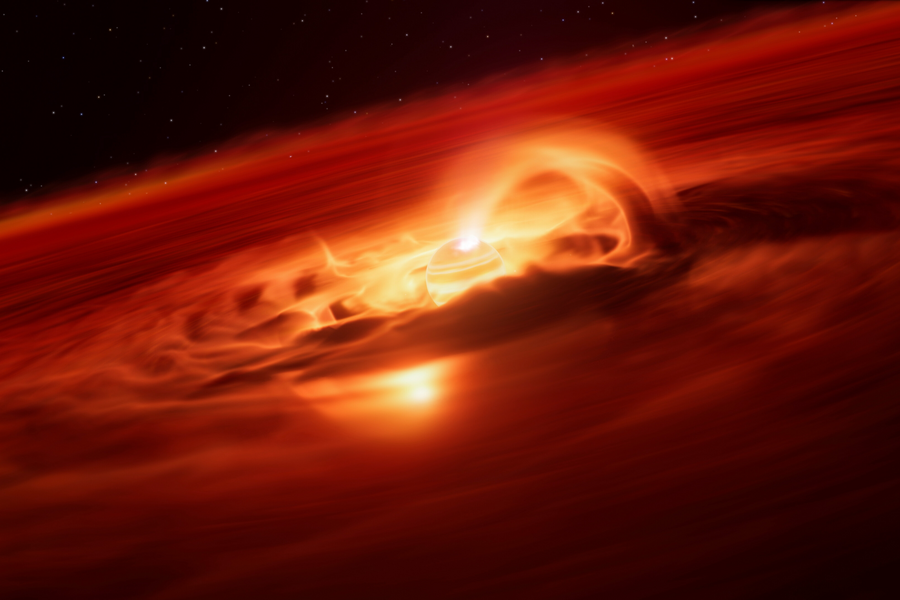
Schematic of the Wolf 1130ABC triple system, composed of the red dwarf star Wolf 1130A, its close and compact white dwarf companion Wolf 1130B, and the distant brown dwarf tertiary Wolf 1130C. The three components of this system are shown scaled to their relative sizes. (cr: Adam Burgasser)
<関連情報>
- https://today.ucsd.edu/story/detection-phosphine-brown-dwarf
- https://www.science.org/doi/10.1126/science.adu0401
低温褐色矮星の大気中の非枯渇ホスフィンの観測 Observation of undepleted phosphine in the atmosphere of a low-temperature brown dwarf
Adam J. Burgasser, Eileen C. Gonzales, Samuel A. Beiler, Channon Visscher, […] , and Christopher A. Theissen
Science Published:2 Oct 2025
DOI:https://doi.org/10.1126/science.adu0401
Abstract
The atmospheres of low-temperature brown dwarfs and gas giant planets are expected to contain the phosphine molecule, PH3. However, previous observations have shown much lower abundances of this molecule than predicted by atmospheric chemistry models. We report JWST spectroscopic observations of phosphine in the atmosphere of the brown dwarf Wolf 1130C. Multiple absorption lines due to phosphine are detected around 4.3 μm, from which we calculate a phosphine abundance of 0.100 ± 0.009 parts per million. This abundance is consistent with disequilibrium atmospheric chemistry models that reproduce the phosphine abundances in Jupiter and Saturn, and is much higher than abundances previously reported for other brown dwarfs or exoplanets. This difference may be related to the low abundance of elements heavier than helium in Wolf 1130C.