
2025-10-01 愛媛大学
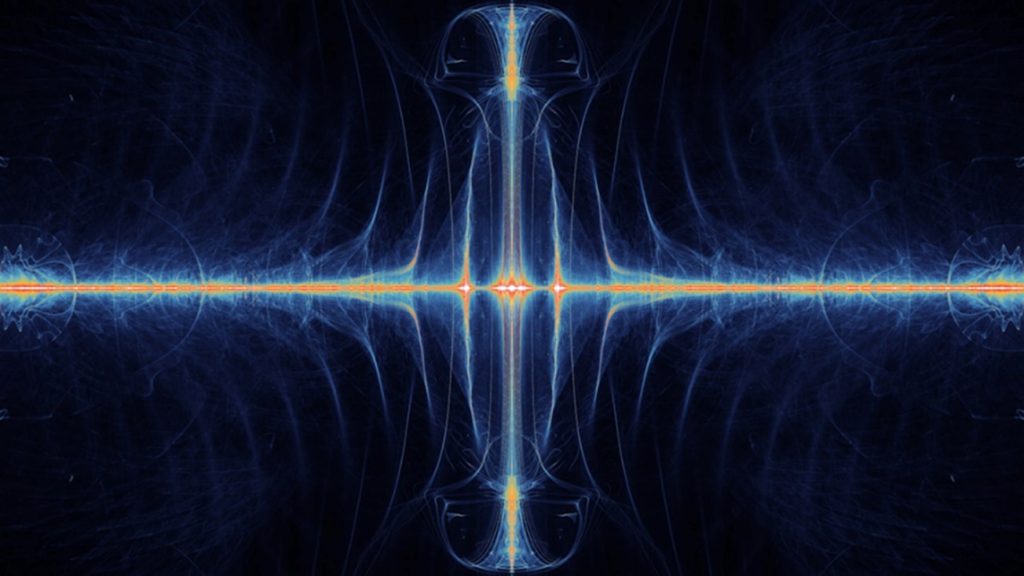 本研究のイメージ図
本研究で実現した不思議な電子の振舞は、アインシュタインの有名な相対性理論で説明されます。次元や時間が絡ん
だ抽象的な世界観が、現実の物質中の電子の振舞と結びつく点に自然界の奥深さを感じます。
<関連情報>
- https://www.ehime-u.ac.jp/data_relese/pr_20251001_sci/
- https://www.ehime-u.ac.jp/wp-content/uploads/2025/10/pr_20251001_sci-1.pdf
- https://journals.iucr.org/paper?vp3047
直線型金(I)錯体を用いた有機ディラック電子系関連物質
Compounds related to organic Dirac electron systems (ODES) using linear gold(I) complex anions
Shoma Yamamoto and Toshio Naito
Structural Chemistry Published:2025
DOI:https://doi.org/10.1107/S2053229625008204
Bis[bis(ethylenedithio)tetraselenafulvalene(0.5+)] dibromidoaurate(I) and its chloride analogue, (C10H8S4Se4)2[AuX2] or BETS2AuX2 (X = Cl and Br), were synthesized to examine their crystal and band structures. The crystal structures are new in that they have both structural features of different types of organic Dirac electron systems (ODES), i.e. α- and α′-type iodine-centred trihalide (IX2−) salts of BETS-related electron-donor molecules. The former often produces zero-gap semiconductors, while the latter is related to nodal-line semimetals, i.e. classes of ODES different from each other. The band structure calculation suggests that BETS2AuX2 are close to zero-gap semiconductors, indicating that the α-type structural feature governs the band structures in these salts. Although the dimensions and geometries of the constituents are close to each other between BETS2IX2 and BETS2AuX2, the strength of the BETS–anion interaction resulted in a difference in the crystal structures between the α- and α′-type molecular arrangements. Our findings show that the crystal and band structures are affected by the electronic states of the constituents sometimes more than one would expect based on their geometrical features



