
2025-09-29 ミネソタ大学
<関連情報>
- https://cse.umn.edu/college/news/steel-making-could-get-makeover
- https://www.nature.com/articles/s41467-025-62639-4
ナノスケールオペランドTEMによる非熱プラズマによる鉄酸化物還元のメカニズムの解明 Revealing the mechanisms of non-thermal plasma-enabled iron oxide reduction through nanoscale operando TEM
Jae Hyun Nam,K. Andre Mkhoyan,Daan Hein Alsem & Peter J. Bruggeman
Nature Communications Published:14 August 2025
DOI:https://doi.org/10.1038/s41467-025-62639-4
Abstract
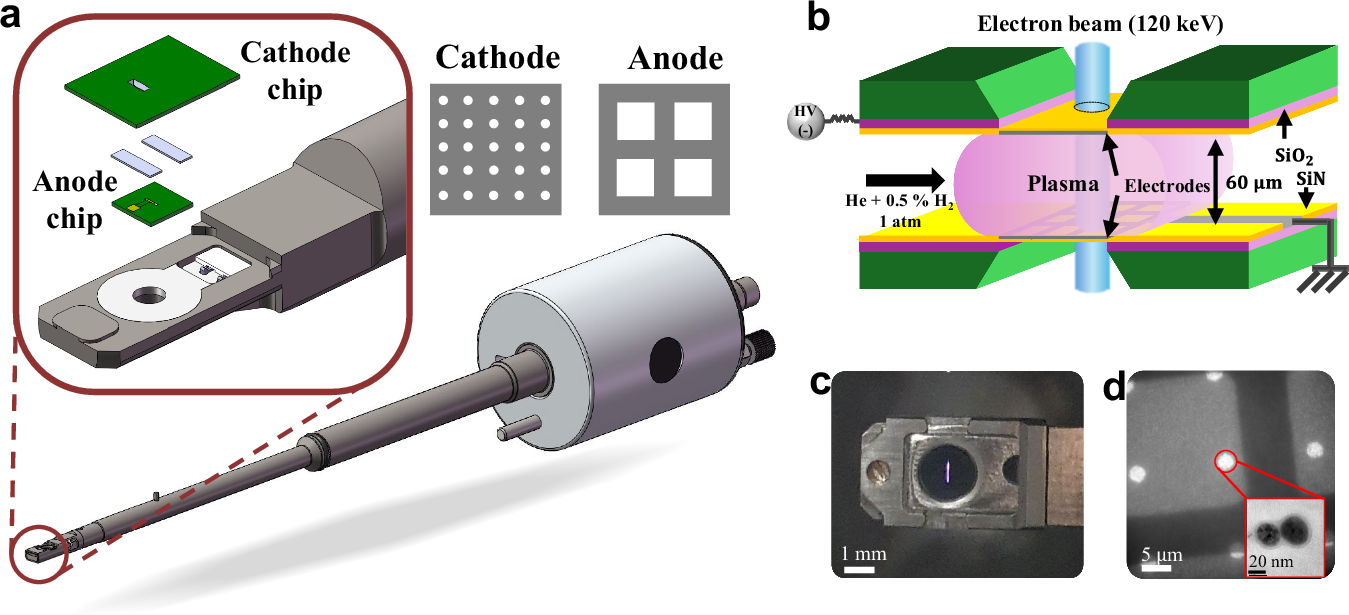
H2 plasma-enabled reduction of iron ore is a promising green alternative for reducing CO2 emissions in the iron and steelmaking industry. In this work, we develop an operando plasma transmission electron microscopy (TEM) technique enabling the direct and real-time observation of magnetite (Fe3O4) nanoparticle reduction by non-thermal H2 plasma with a spatial resolution of ~1 nm. Our operando results show a decrease in particle size accompanied by crack formation on timescales of ~10 s. We reveal that these observations are due to the oxide reduction, which induces a change in crystal structure from magnetite to iron, driven by the hydrogen radical, H•. The operando reduction in particle volume by the plasma is well described by a shrinking-core reaction model. Our findings provide critical insights into mechanisms and rate-controlling processes of non-thermal iron ore reduction at the nanoscale. The developed operando plasma TEM technique is expected to find widespread application with the advent of non-thermal plasma technologies and the growing demands for diagnostic techniques to enhance mechanistic understandings in the field of plasma-nanoengineering.


