2025-09-25 国際農研,北海道大学
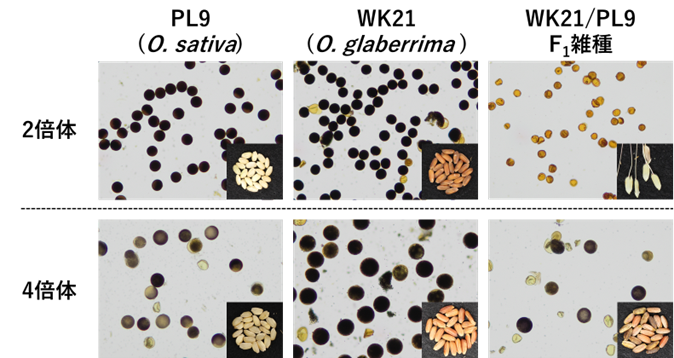
図1 親系統およびF1雑種の花粉稔性
<関連情報>
- https://www.jircas.go.jp/ja/release/2025/press202515
- https://www.jircas.go.jp/system/files/press/press202515.pdf
- https://link.springer.com/article/10.1007/s00122-025-04901-3
四倍体化とその減少によって促進されたアジアとアフリカのイネ種間の稔性二倍体雑種 Fertile interspecific diploid hybrids between the Asian and African rice species facilitated by tetraploidization and its reduction
Daichi Kuniyoshi &Yuji Kishima
Theoretical and Applied Genetics Published:27 June 2025
DOI:https://doi.org/10.1007/s00122-025-04901-3
Abstract
Key message
We developed fertile diploid interspecific hybrids that were genetically balanced between the Asian rice, Oryza sativa, and the African rice, Oryza glaberrima, through tetraploidization and subsequent diploid induction.
Abstract
Interspecific hybrids between the Asian rice, Oryza sativa, and the African rice, O. glaberrima, show severe pollen grain sterility owing to the sterility effect of multiple hybrid sterility (HS) genes/loci. These HS loci only cause pollen grain sterility in heterozygotic situations; therefore, interspecific hybrids can be made fertile by fixing all HS loci as homozygous if the hybrids inherit the genomes from both species equally. Such genetically balanced hybrids can combine the superior traits of both species. However, a method for developing balanced hybrids with fixed HS loci is lacking. Previously, a diploid interspecific hybrid population was obtained through anther culture of tetraploid interspecific hybrids, and in this study, 22 double haploid (DH) plants were developed through anther culture of the diploid interspecific hybrids. The DH plants were genetically fixed, including the HS loci, and confirmed to be genetically balanced between the two species. Nine of the DH plants showed a pollen fertility of more than 60%, and the progeny DH lines developed through self-pollination of the DH plants varied phenotypically for each line. These results demonstrate that genetically balanced hybrids between O. sativa and O. glaberrima with fixed HS loci can be developed through successive anther cultures of tetraploid interspecific hybrids. The balanced hybrids maintained the genome of O. glaberrima at higher ratios than traditional backcrossing varieties. Therefore, this breeding strategy using tetraploid hybrids as intermediators for the development of balanced diploid hybrids will provide new interspecific varieties that combine the superior traits of both species.