2025-09-18 マサチューセッツ工科大学(MIT)
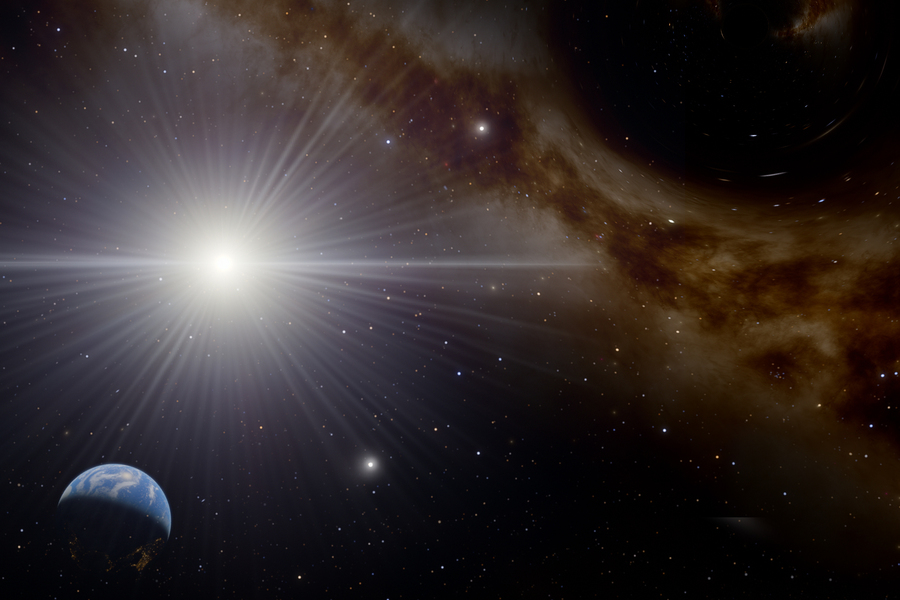
An artist’s illustration showing a tiny black hole within our Milky Way galaxy (top right), which could emit a burst of energetic particles due to Hawking radiation, a few of which would be detected on Earth (lower left). Such ultrahigh-energy particles could explain rare cosmic ray phenomena, such as the highest-energy neutrino ever detected.
Credit: Image by Toby Gleason-Kaiser, using SpaceEngine @ Cosmographic Software LLC.
<関連情報>
- https://news.mit.edu/2025/could-primordial-black-holes-last-burst-explain-mysteriously-energetic-neutrino-0918
- https://journals.aps.org/prl/abstract/10.1103/vnm4-7wdc
原始ブラックホール由来の超高エネルギーニュートリノ Ultrahigh-Energy Neutrinos from Primordial Black Holes
Alexandra P. Klipfel and David I. Kaiser
Physical Review Letters Published: 18 September, 2025
DOI: https://doi.org/10.1103/vnm4-7wdc
Abstract
The KM3NeT Collaboration recently announced the detection of a neutrino with energy 220 PeV. One possible source of such ultrahigh-energy particles is the rapid emission of energetic Hawking radiation from a primordial black hole (PBH) near the end of its evaporation lifetime. The mass distribution for PBHs features a power-law tail for small masses; a small subset of PBHs would be undergoing late-stage evaporation today. We find that recent high-energy neutrino events detected by the IceCube and KM3NeT Collaborations, with energies (1−102) PeV, are consistent with event-rate expectations if a significant fraction of the dark matter consists of PBHs.