2025-09-08 中国科学院(CAS)
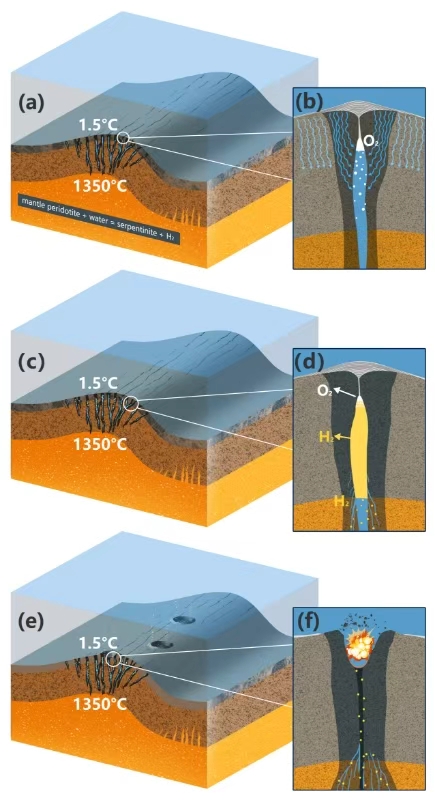
Mechanism diagram showing the explosion process to form the pipe swarm in hydrothermal system. (Image by Prof. XIAO Yuanyuan et al.)
<関連情報>
- https://english.cas.cn/newsroom/research_news/earth/202509/t20250902_1052625.shtml
- https://www.science.org/doi/10.1126/sciadv.adx2600
西太平洋カロラインプレート東部における水素豊富な熱水系に付随する角礫岩パイプの形成 Formation of breccia pipes associated with a hydrogen-rich hydrothermal system on the east Caroline plate in the West Pacific
Yuanyuan Xiao, Kun Wang, Yuan Wang, Shuai Yuan, […] , and Weidong Sun
Science Advances Published:5 Sep 2025
DOI:https://doi.org/10.1126/sciadv.adx2600

Abstract
A large hydrothermal field at depths >4300 meters was found on the east Caroline plate in the western Pacific Ocean. Here, we show that large hydrothermal pipes with steep walls and breccia-dominated bottoms suggest explosions of billion metric tons of TNT (trinitrotoluene) equivalent. More than 800 short-duration seismic events were detected within 28 days along a 150-kilometer profile, indicating widespread ongoing explosive gas release. We suggest that billions of tons of hydrogen gas were produced through serpentinization associated with fluid infiltration via fractures formed by bending of the oceanic plate. Hydrogen was retained in fractures sealed by mud and carbonate. However, hydrogen alone cannot produce the explosive capacity responsible for the formation of pipes. Oxygen released from circulating seawater can be concentrated at crustal depths and then mixed with mantle-derived hydrogen. Explosion of the gas mixture releases large amounts of heat that triggers further explosions of compressed hydrogen gas and results in the formation of hydrothermal pipes.