2025-09-05 中国科学院(CAS)
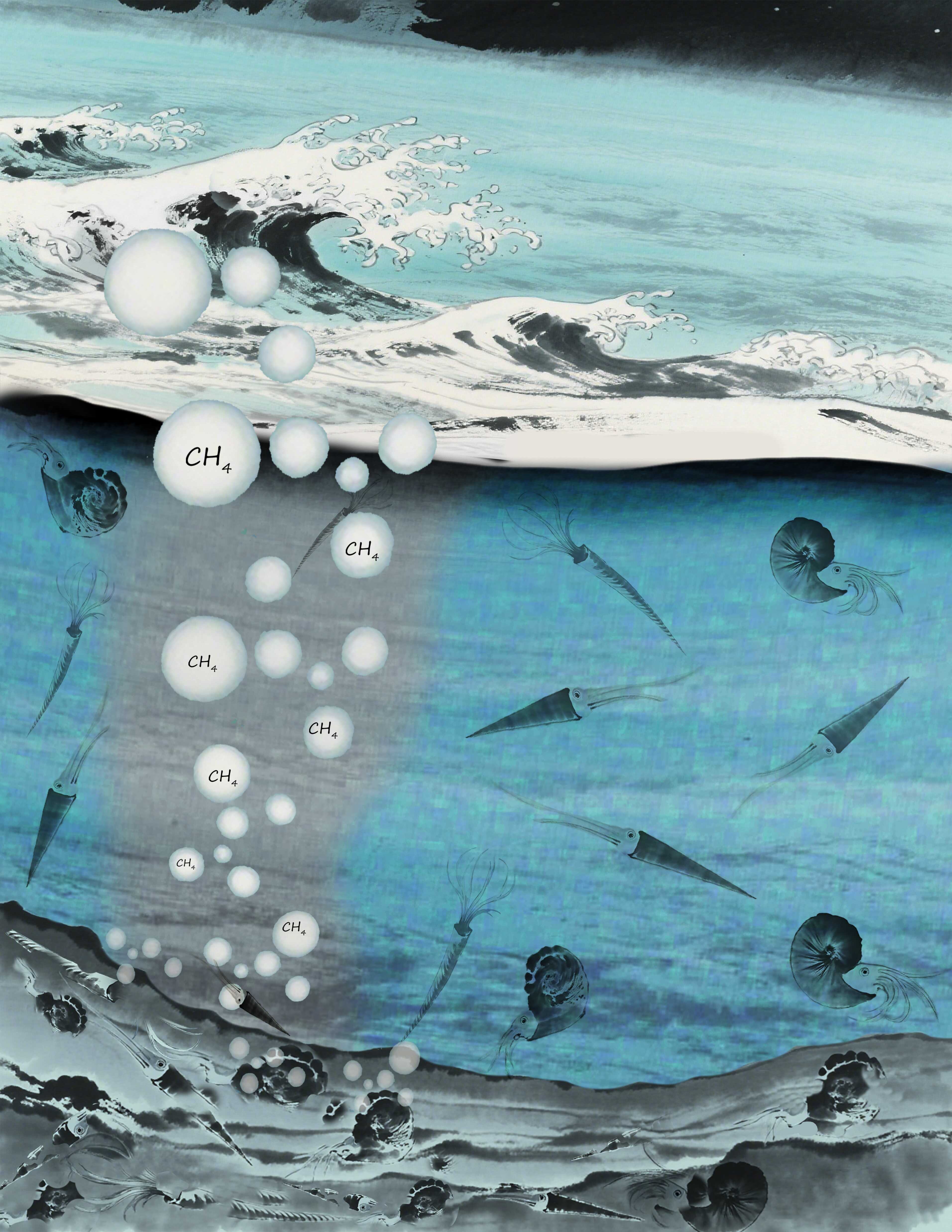
Artistic illustration of methane release from seafloor sediments into the ocean and atmosphere during the T-OAE, highlighting its role in climate warming and marine ecosystem disruption. (Image by QIU Ruoyuan)
<関連情報>
- https://english.cas.cn/newsroom/research_news/earth/202509/t20250904_1053876.shtml
- https://www.pnas.org/doi/10.1073/pnas.2423598122
トーアシアン海洋無酸素事象における断続的温暖化を伴うパルス状の生物起源メタン放出 Pulsed biogenic methane emissions coupled with episodic warming during the Toarcian Oceanic Anoxic Event
Ruoyuan Qiu, Zhichao Yu, Benjamin J. W. Mills, +6 , and Zhijun Jin
Proceedings of the National Academy of Sciences Published:September 2, 2025
DOI:https://doi.org/10.1073/pnas.2423598122
Significance
Large-scale release of biogenic methane has the potential to contribute to significant climate change, yet its role during hyperthermal events remains debated. Our results demonstrate that biogenic methane release played a pivotal role during the Toarcian Oceanic Anoxic Event (T-OAE). Episodic pulses of biogenic methane drove abrupt spikes in atmospheric methane concentrations and surface temperature increases of approximately 2 °C. These findings highlight the potential for methane feedback loops to exacerbate climate change, offering critical insights for predicting the dynamics of anthropogenic warming.
Abstract
Reconstructing carbon release fluxes during ancient climatic warming events is important for improving predictions of carbon cycle and climate dynamics under future anthropogenic warming scenarios. We investigate the extent of biogenic methane release and its contribution to climate variability across the Toarcian Oceanic Anoxic Event (T-OAE) approximately 183 million years ago. To do this, we developed a global biogeochemical model and applied a Bayesian inversion using Markov Chain Monte Carlo (MCMC) simulations. Based on a high-resolution record of carbon isotope excursions from the Yorkshire section, our results indicate that a release of at least 4,700 Gt carbon from biogenic CH4 (with a carbon isotopic composition, δ13C of −50 to −70‰) is necessary to accurately reproduce the pronounced pulsed shift in the δ13C, as well as the inferred changes in atmospheric pCO2 and global temperature. This massive methane release may have led to a substantial increase in atmospheric pCH4 and contributed to additional global surface warming, perhaps by more than 2 °C. We further elucidate that the liberation of methane may have been facilitated by an upsurge in methanogenesis alongside a concomitant decline in methane oxidation within organic-rich, sulfate-depleted marine environments. An active CH4 cycle represents a positive feedback mechanism that exacerbates environmental deterioration during climatic warming events, ultimately contributing to mass extinction of marine life.