2025-09-04 ブラウン大学
Web要約 の発言:
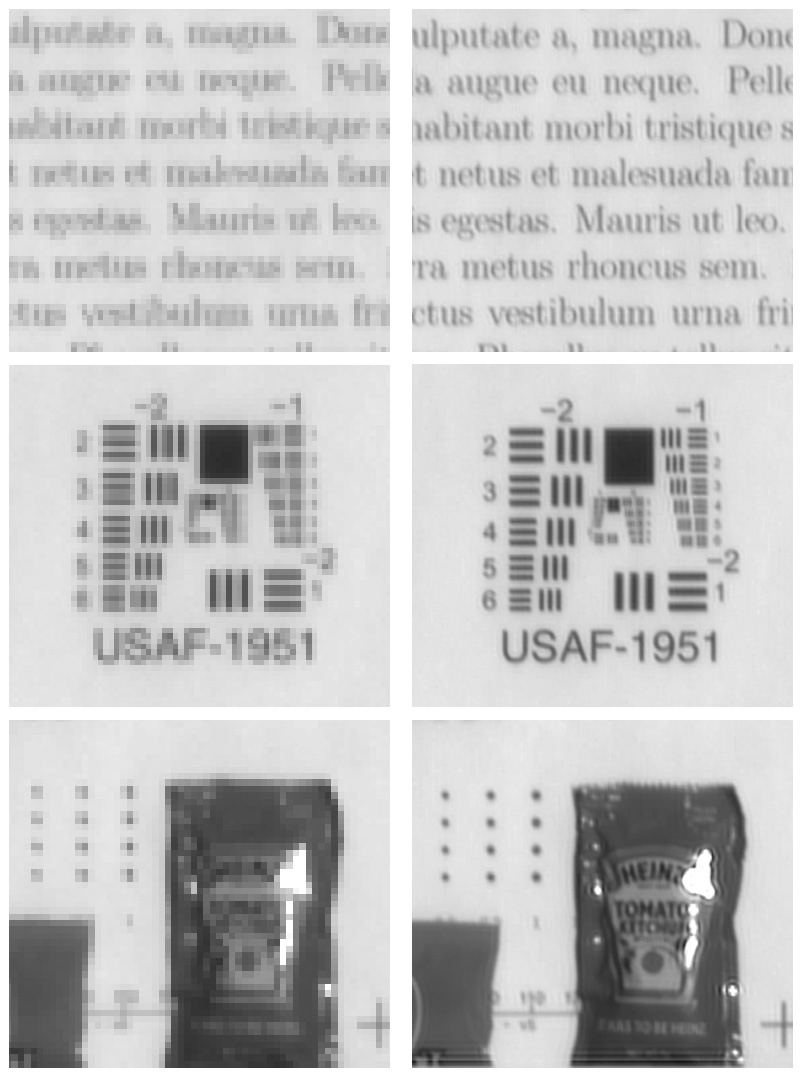
Images on the left were taken while the camera moved. Images on the right were enhanced using the new motion algorithm.
<関連情報>
構造化運動を用いた超解像 Super-Resolution with Structured Motion
Gabby Litterio, Juan-David Lizarazo-Ferro, Pedro Felzenszwalb, Rashid Zia
arXiv last revised 24 Jun 2025 (this version, v2)
DOI:https://doi.org/10.48550/arXiv.2505.15961
Abstract
We consider the limits of super-resolution using imaging constraints. Due to various theoretical and practical limitations, reconstruction-based methods have been largely restricted to small increases in resolution. In addition, motion-blur is usually seen as a nuisance that impedes super-resolution. We show that by using high-precision motion information, sparse image priors, and convex optimization, it is possible to increase resolution by large factors. A key operation in super-resolution is deconvolution with a box. In general, convolution with a box is not invertible. However, we obtain perfect reconstructions of sparse signals using convex optimization. We also show that motion blur can be helpful for super-resolution. We demonstrate that using pseudo-random motion it is possible to reconstruct a high-resolution target using a single low-resolution image. We present numerical experiments with simulated data and results with real data captured by a camera mounted on a computer controlled stage.