2025-09-02 マサチューセッツ工科大学(MIT)
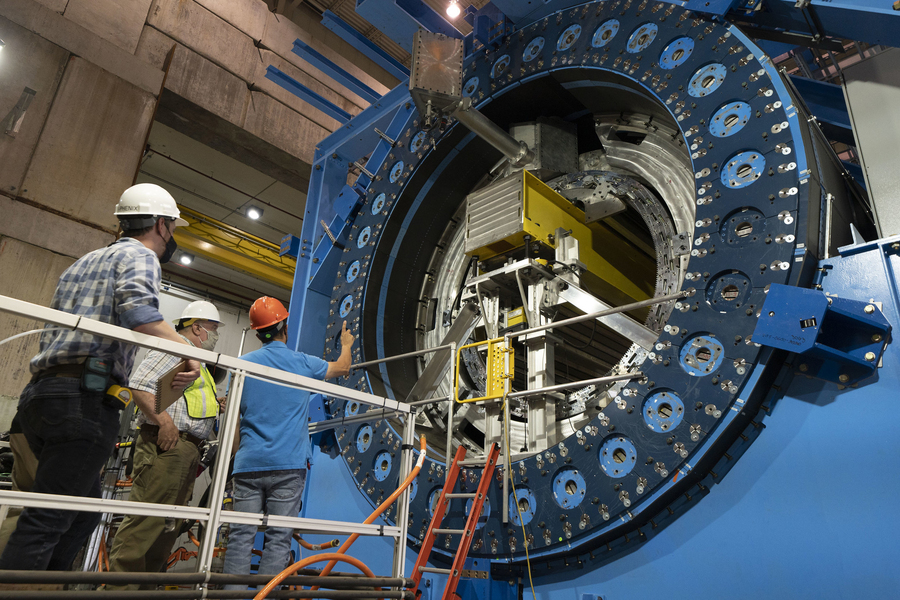
The sPHENIX detector is the newest experiment at Brookhaven National Laboratory’s Relativistic Heavy Ion Collider (RHIC) and is designed to precisely measure products of high-speed particle collisions. This image shows the installation of the inner hadronic calorimeter within the core of the sPHENIX superconducting solenoid magnet.
Credit: Courtesy of Brookhaven National Laboratory
<関連情報>
- https://news.mit.edu/2025/new-particle-detector-passes-standard-candle-test-0902
- https://link.springer.com/article/10.1007/JHEP08(2025)075
√sNN=200 GeVにおけるAu+Au衝突でのsPHENIX検出器による荷電ハドロン多重度測定 Measurement of charged hadron multiplicity in Au+Au collisions at √sNN= 200 GeV with the sPHENIX detector
The sPHENIX collaboration,M. I. Abdulhamid,U. Acharya,E. R. Adams,G. Adawi,C. A. Aidala,Y. Akiba,M. Alfred,S. Ali,A. Alsayegh,S. Altaf,H. Amedi,D. M. Anderson,V. V. Andrieux,A. Angerami,N. Applegate,H. Aso,S. Aune,B. Azmoun,V. R. Bailey,D. Baranyai,S. Bathe,A. Bazilevsky,S. Bela,… C. Zimmerli
Journal of High Energy Physics Published:12 August 2025
DOI:https://doi.org/10.1007/JHEP08(2025)075
Abstract
The pseudorapidity distribution of charged hadrons produced in Au+Au collisions at a center-of-mass energy of √sNN= 200 GeV is measured using data collected by the sPHENIX detector. Charged hadron yields are extracted by counting cluster pairs in the inner and outer layers of the Intermediate Silicon Tracker, with corrections applied for detector acceptance, reconstruction efficiency, combinatorial pairs, and contributions from secondary decays. The measured distributions cover |η| < 1.1 across various centralities, and the average pseudorapidity density of charged hadrons at mid-rapidity is compared to predictions from Monte Carlo heavy-ion event generators. This result, featuring full azimuthal coverage at mid-rapidity, is consistent with previous experimental measurements at the Relativistic Heavy Ion Collider, thereby supporting the broader sPHENIX physics program.