2025-09-02 中国科学院(CAS)
<関連情報>
- https://english.cas.cn/newsroom/research_news/phys/202509/t20250903_1052728.shtml
- https://academic.oup.com/mnras/article/541/4/3353/8215208
パミール高原ムズタガ・アタ観測点北1・北2地点における視程観測と気象分析 Seeing and meteorological analysis at the North-1 and North-2 points of Muztagh-Ata site on the Pamir Plateau
Wenbo Gu, Ali Esamdin, Cunhai Bai, Jicheng Zhang, Xuan Zhang, Guojie Feng, Letian Wang, Guangxin Pu, Xinliang Wang, Daiping Zhang
Monthly Notices of the Royal Astronomical Society Published:28 July 2025
DOI:https://doi.org/10.1093/mnras/staf1210
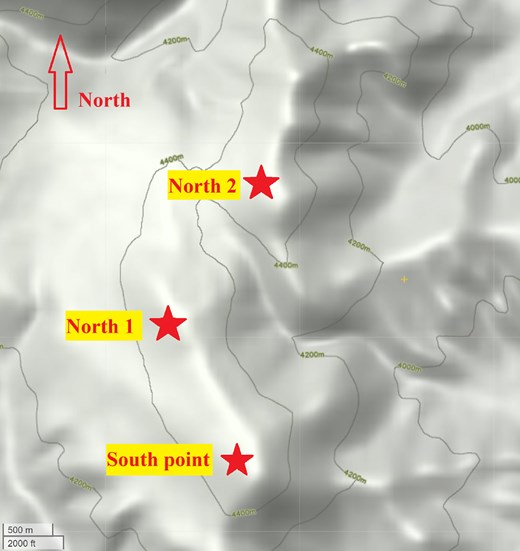
ABSTRACT
To support the selection of large optical/infrared telescope sites in western China, long-term monitoring of atmospheric conditions and astronomical seeing has been conducted at the Muztagh-Ata site on the Pamir Plateau since 2017. With the monitoring focus gradually shifting northward, three stations were established: the South point, North-1 point, and North-2 point. The North-1 point, selected as the site for the 1.93-m Muztagh Optical Survey Telescope, has recorded seeing and meteorological parameters since late 2018. In 2023, the North-2 point was established approximately 1.5 km north-east of the North-1 point as a candidate location for a future large-aperture telescope. A 10-m Differential Image Motion Monitor tower and a PC-4A environmental monitoring system were installed to evaluate site quality. This study presents a comparative analysis of data from the North-1 and North-2 points during 2018–2024. The median seeing is 0.89 arcsec at North-1 and 0.78 arcsec at North-2. Both points show clear seasonal and diurnal variations, with winter nights offering optimal observing conditions. On average, about 64 per cent of the nighttime duration per year is suitable for astronomical observations. Nighttime temperature variation is low:2.03℃ at 2.10℃ North-1 and at North-2. Median wind speeds are 5–6 m s−1, with dominant directions between 210° and 300° , contributing to stable airflow. Moderate wind suppresses turbulence, while strong shear and rapid fluctuations degrade image quality. These findings confirm that both the North-1 and North-2 points offer high-quality atmospheric conditions and serve as promising sites for future ground-based optical/infrared telescopes in western China.