2025-09-03 中国科学院(CAS)
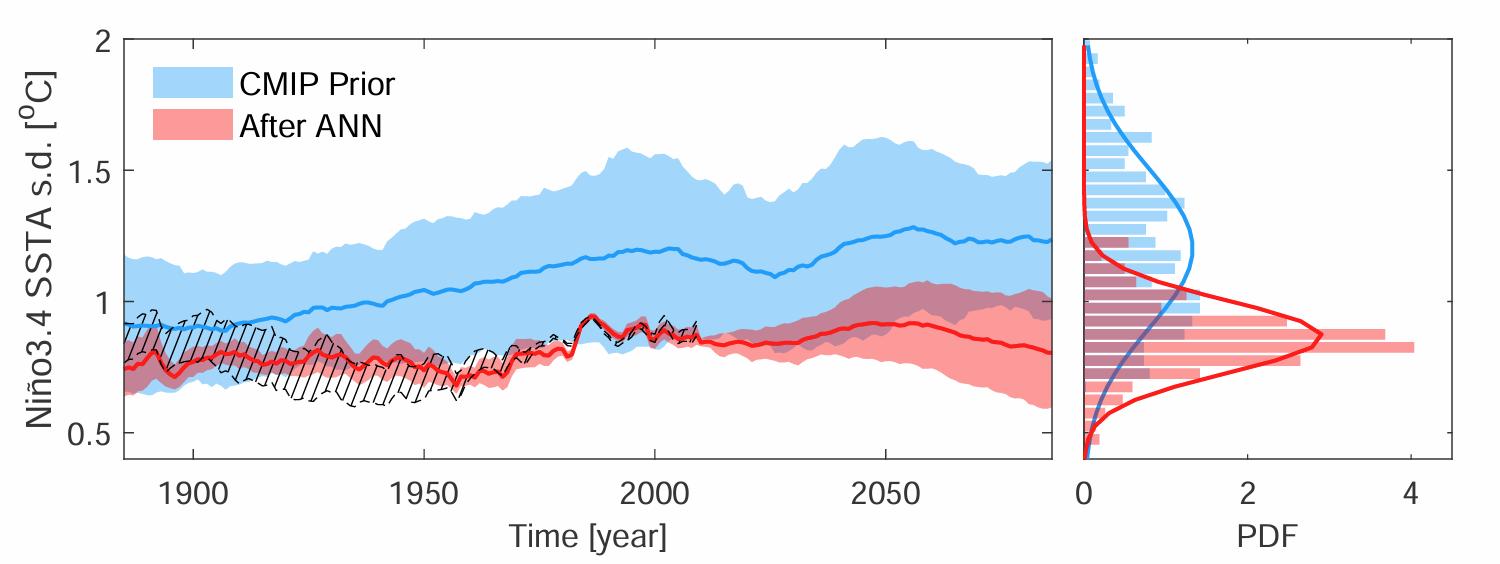
Reduced uncertainty in ENSO SST amplitude projections using deep learning. (Image by IOCAS)
<関連情報>
- https://english.cas.cn/newsroom/research_news/earth/202509/t20250903_1052718.shtml
- https://www.nature.com/articles/s41467-025-63157-z
観測データに基づく深層学習を用いたENSO予測 Projection of ENSO using observation-informed deep learning
Yuchao Zhu,Rong-Hua Zhang,Fan Wang,Wenju Cai,Delei Li,Shoude Guan & Yuanlong Li
Nature Communications Published:19 August 2025
DOI:https://doi.org/10.1038/s41467-025-63157-z
Abstract
The El Niño-Southern Oscillation (ENSO) profoundly impacts global climate, but its sea surface temperature (SST) variability projected by climate models remains uncertain, with a substantial inter-model spread in 21st-century projections. Model-observation discrepancies in ENSO physics contribute to this uncertainty, necessitating observational constraints to refine projections. However, methods to achieve this constraint remain unclear. Here, we show that deep learning informed by the observed response of ENSO SST variability to tropical Pacific warming patterns reduces projection uncertainty by 54% under a high-emission scenario. Specifically, artificial neural networks (ANNs), trained on climate model simulations and observations, successfully capture the real-world ENSO response. Interpretability analyses reveal that replicating observed ENSO physics by ANNs is critical, identifying warming in the far-eastern and central equatorial Pacific as key to ENSO change. A model-as-truth approach further confirms the robustness of ANN-generated projections. By conditioning future ENSO SST variability projection on the ANN-inferred ENSO response to tropical Pacific warming, uncertainty is reduced from a range of 0.59 °C to 0.27 °C. Our results highlight the prospect of integrating machine learning with observations to reduce uncertainty in climate projections.