
2025-08-29 ペンシルベニア州立大学(PennState)
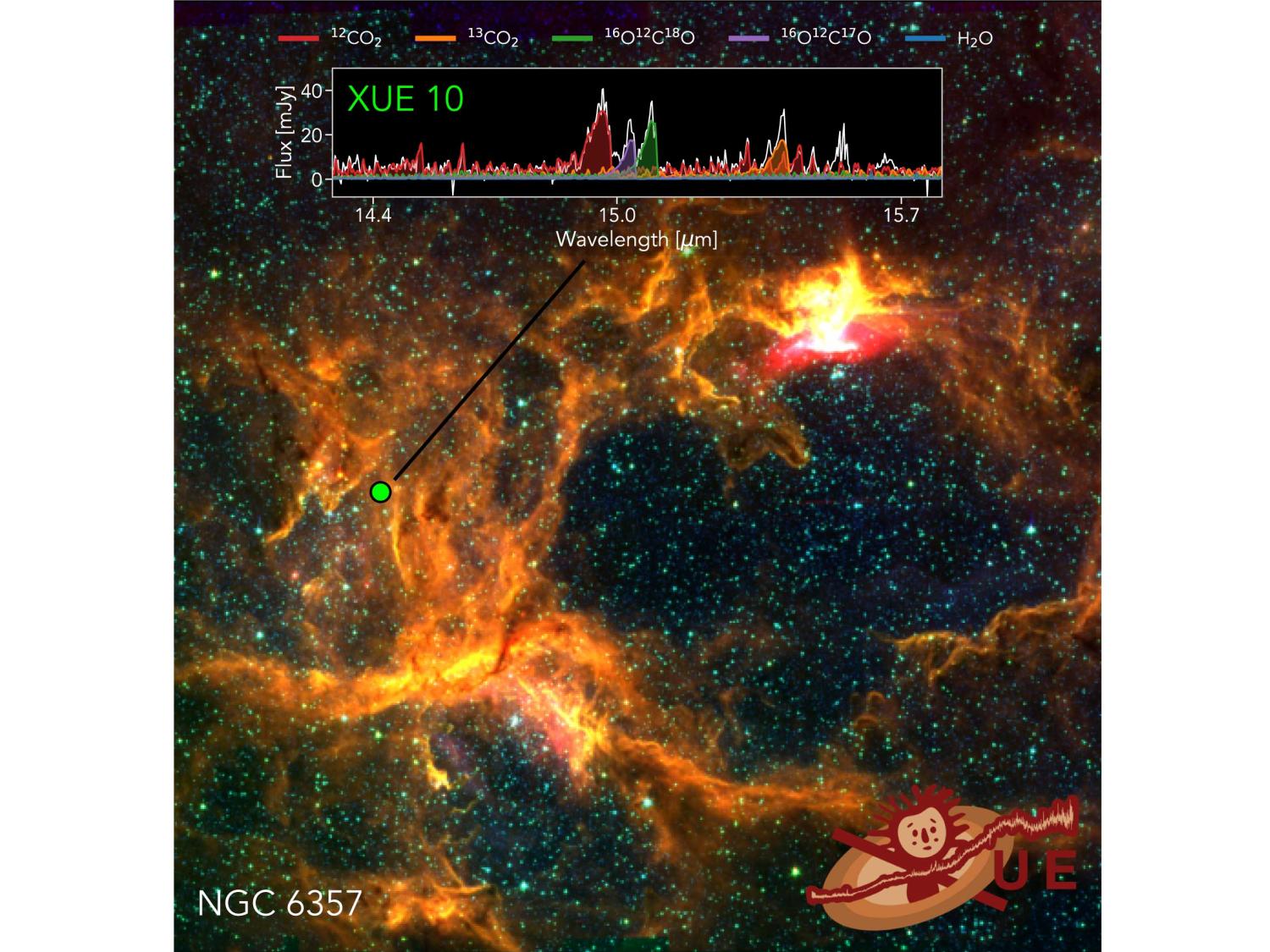
A newly discovered planet-forming disk has a an unexpectedly high abundance of carbon dioxide in regions where Earth-like planets may one day form. The discovery challenges long-standing assumptions about the chemistry of planetary birthplaces, the researchers said. Credit: XUE collaboration. All Rights Reserved.
<関連情報>
- https://www.psu.edu/news/eberly-college-science/story/abundant-carbon-dioxide-planet-forming-disk-challenges-planet-origin
- https://www.aanda.org/articles/aa/full_html/2025/09/aa55718-25/aa55718-25.html
XUE:外部照射を受けたハービグ円盤におけるCO2豊富な地球型惑星形成領域 XUE: The CO2-rich terrestrial planet-forming region of an externally irradiated Herbig disk
Jenny Frediani, Arjan Bik, María Claudia Ramírez-Tannus, Rens Waters, Konstantin V. Getman, Eric D. Feigelson, Bayron Portilla-Revelo, Benoît Tabone, Thomas J. Haworth, Andrew Winter, Thomas Henning, Giulia Perotti, Alexis Brandeker, Germán Chaparro, Pablo Cuartas-Restrepo, Sebastian Hernández A., Michael A. Kuhn, Thomas Preibisch, Veronica Roccatagliata, Sierk E. van Terwisga and Peter Zeidler
Astronomy & Astrophysics Published:29 August 2025
DOI:https://doi.org/10.1051/0004-6361/202555718
Abstract
Aims. We investigate the James Webb Space Telescope (JWST) MIRI MRS gas molecular content of an externally irradiated Herbig disk, the F-type XUE 10 source, in the context of the eXtreme UV Environments (XUE) program. XUE 10 belongs to the massive star cluster NGC 6357 (1.69 kpc), where it is exposed to an external far-ultraviolet (FUV) radiation ≈103 times stronger than in the solar neighborhood.
Methods. We modeled the molecular features in the mid-infrared spectrum with local thermodynamic equilibrium (LTE) 0D slab models. We derived basic parameters of the stellar host from a VLT FORS2 optical spectrum using PHOENIX stellar templates.
Results. We detected bright CO2 gas with the first simultaneous detection (>5σ) of four isotopologues (12CO2, 13CO2, 16O12C18O, 16O12C17O) in a protoplanetary disk. We also detected faint CO emission (2σ) and the HI Pf α line (8σ). We placed strict upper limits on the water content, finding a total column density of ≲1018 cm−2. The CO2 species trace low gas temperatures (300–370 K) with a range of column densities of 7.4 × 1017 cm−2 (16O12C17O)−1.3 × 1020 cm−2 (12CO2) in an equivalent emitting radius of 1.15 au. The emission of 13CO2 is likely affected by line optical depth effects. The 16O12C18O and 16O12C17O abundances may be isotopically anomalous compared to the 16O/18O and 16O/17O ratios measured in the interstellar medium and the Solar System.
Conclusions. We propose that the mid-infrared spectrum of XUE 10 is explained by H2O removal either via advection or strong photo-dissociation by stellar UV irradiation and enhanced local CO2 gas phase production. Outer disk truncation supports the observed CO2−H2O dichotomy. A CO2 vapor enrichment in 18O and 17O can be explained by means of external UV irradiation and early (104–5 yr) delivery of isotopically anomalous water ice to the inner disk.


