
2025-08-25 中国科学院(CAS)
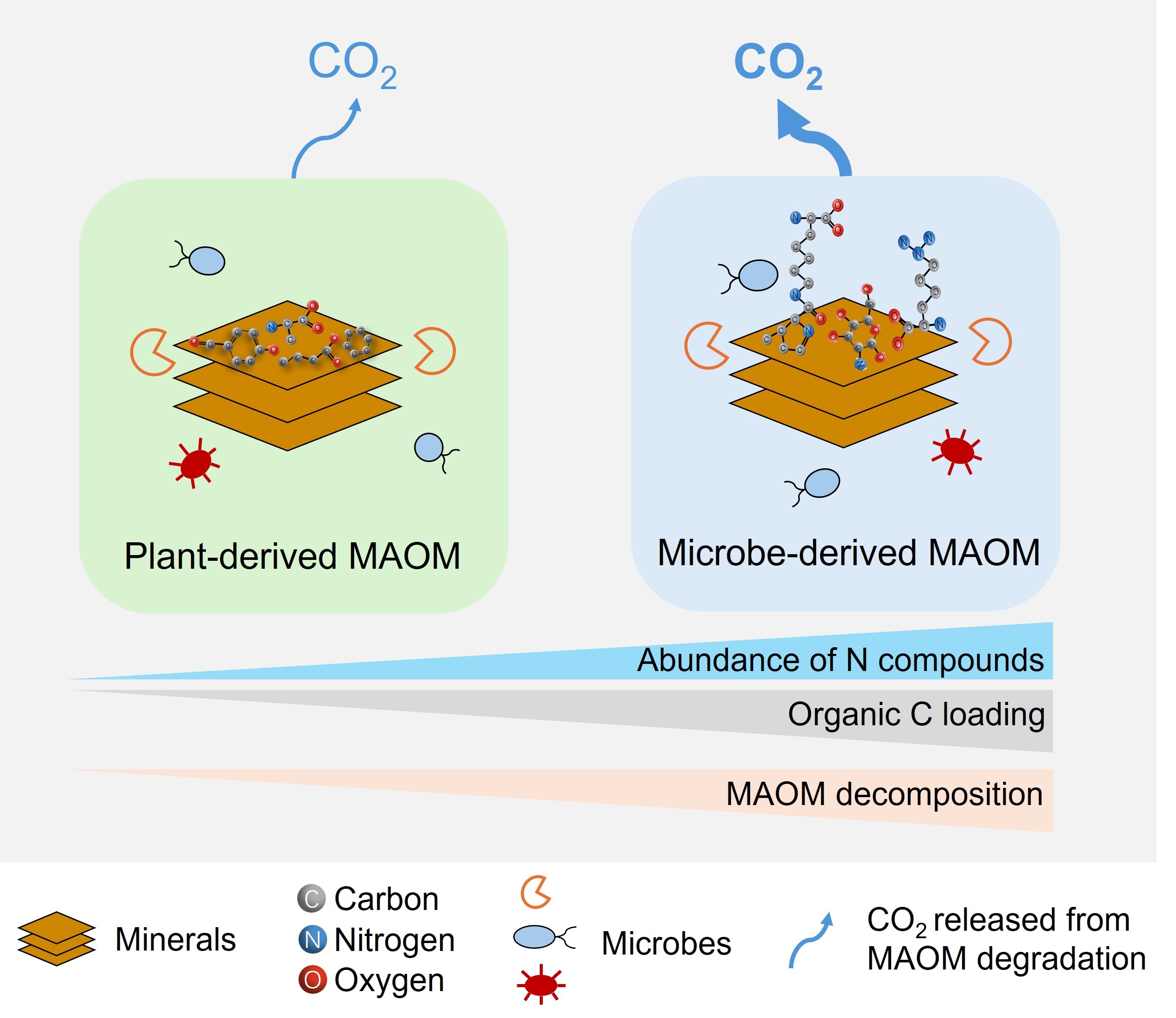 Conceptual figure illustrating mineral-associated organic matter (MAOM) decomposition related to N compounds and organic carbon (C) loadings. (Image by JIA Juan)
<関連情報>
- https://english.cas.cn/newsroom/research_news/life/202508/t20250827_1051439.shtml
- https://onlinelibrary.wiley.com/doi/10.1111/gcb.70448
土壌中の窒素豊富鉱物関連有機物の高速分解 Fast Decomposition of Nitrogen-Rich Mineral-Associated Organic Matter in Soils
Juan Jia, Guoqing Zhai, Yufu Jia, Xiaojuan Feng
Global Change Biology Published: 19 August 2025
DOI:https://doi.org/10.1111/gcb.70448
ABSTRACT
Mineral-associated organic matter (MAOM) stores the majority of soil carbon and nitrogen (N) and largely consists of N-rich microbial residues. However, the decomposition potential of MAOM and intrinsic properties regulating MAOM degradation remain poorly understood. Here, we deliberately constructed 13C-labeled microbe- and plant-derived MAOM with varying molecular compositions and organic carbon (OC) loadings and conducted three independent microcosm experiments to investigate how MAOM’s intrinsic properties influence its persistence in soils. Microbial decomposition of MAOM was monitored by measuring the rate and isotopic signature of respired CO2 during 30-day incubations, while MAOM molecular composition was characterized using pyrolysis-gas chromatography/mass spectrometry and amino acid analysis. We found that MAOM decomposition was positively correlated with the abundance of N compounds (including amino acids), which emerged as the primary predictor of MAOM decomposition across all experiments. Notably, N-rich microbial residues were preferentially sorbed onto minerals coated with organic matter via organo-organic interactions, rather than directly onto unoccupied mineral sites. This association mode, being less stable than direct mineral sorption (i.e., monolayer adsorption), likely facilitated multilayer accumulation of organic matter, resulting in both higher OC loadings and a greater decomposition potential of N-rich MAOM. These findings suggest that N-rich MAOM decomposes rapidly, challenging the prevailing view that microbe-derived N-containing compounds are strongly sorbed to mineral surfaces and resistant to degradation. Furthermore, the high decomposability of OC retained through organo-organic interactions potentially poses an upper limit of carbon retention on MAOM, offering an alternative explanation to carbon saturation other than mineral surface availability. Collectively, this study highlights the need to integrate MAOM properties (composition and OC loading) to better predict the carbon sequestration potentials and dynamics of MAOM in soils.


