2025-08-22 国立環境研究所,産業技術総合研究所,愛媛大学
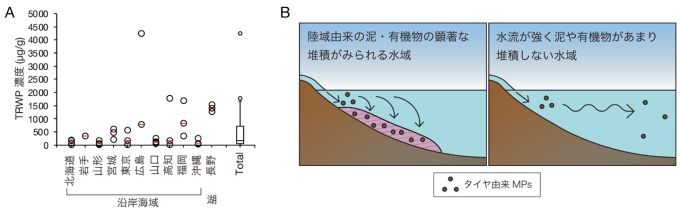
図1.(A)堆積物中タイヤ由来MPs濃度分析結果(赤線は中央値を示す),(B)タイヤ由来MPsの環境中挙動の模式図.
<関連情報>
- https://www.nies.go.jp/whatsnew/2025/20250822/20250822.html
- https://www.sciencedirect.com/science/article/abs/pii/S0043135425011844
海岸と湖の堆積物におけるタイヤ由来粒子の分布と蓄積パターン Distribution and accumulation patterns of tire-derived particles in coastal and lake sediments
Kosuke Tanaka, Atsuko Amano Takuya Itaki, Kei Nakayama, Yusuke Takahashi, Go Suzuki
Water Research Available online: 21 July 2025
DOI:https://doi.org/10.1016/j.watres.2025.124278
Highlights
- Behavior and accumulation of tire-derived particles in aquatic systems were assessed.
- Tire-derived particles were quantified in sediments from 11 Japanese water bodies.
- Tire-derived particles are transported with terrestrially derived substances.
- Sedimentation patterns may indicate the distribution of tire-derived particles.
Abstract
Tire and road wear particles (TRWP) are the largest source of microplastics. These particles are generated through friction between tires and road surfaces during use, enter aquatic environments, and may affect aquatic organisms. In this study, TRWP in sediments from 11 different water bodies in Japan were analyzed using pyrolysis gas chromatography/mass spectrometry. TRWP were detected in 32 out of 36 samples, with concentrations up to 4260 µg/g dry weight. TRWP concentrations exceeded the estimated predicted no-effect concentration threshold at 30 out of 36 sites, indicating that potential ecological risks cannot be ruled out. A correlation was found between TRWP concentration and mud content, total organic carbon, or terrestrial organic carbon (terrOC) at sites where mud accumulates. The correlation between TRWP and terrOC was significant even at sites with a notable contribution of marine-derived mud. These findings suggest that TRWP are transported with terrestrial mud and organic matter in aquatic environments. Moreover, sedimentation patterns, as deduced from sediment properties such as mud content and elemental composition, may serve as indicators of TRWP distribution. This study contributes to transport modeling, environmental risk assessments, and development of future pollution control strategies for TRWP.