2025-08-15 パシフィック・ノースウェスト国立研究所(PNNL)
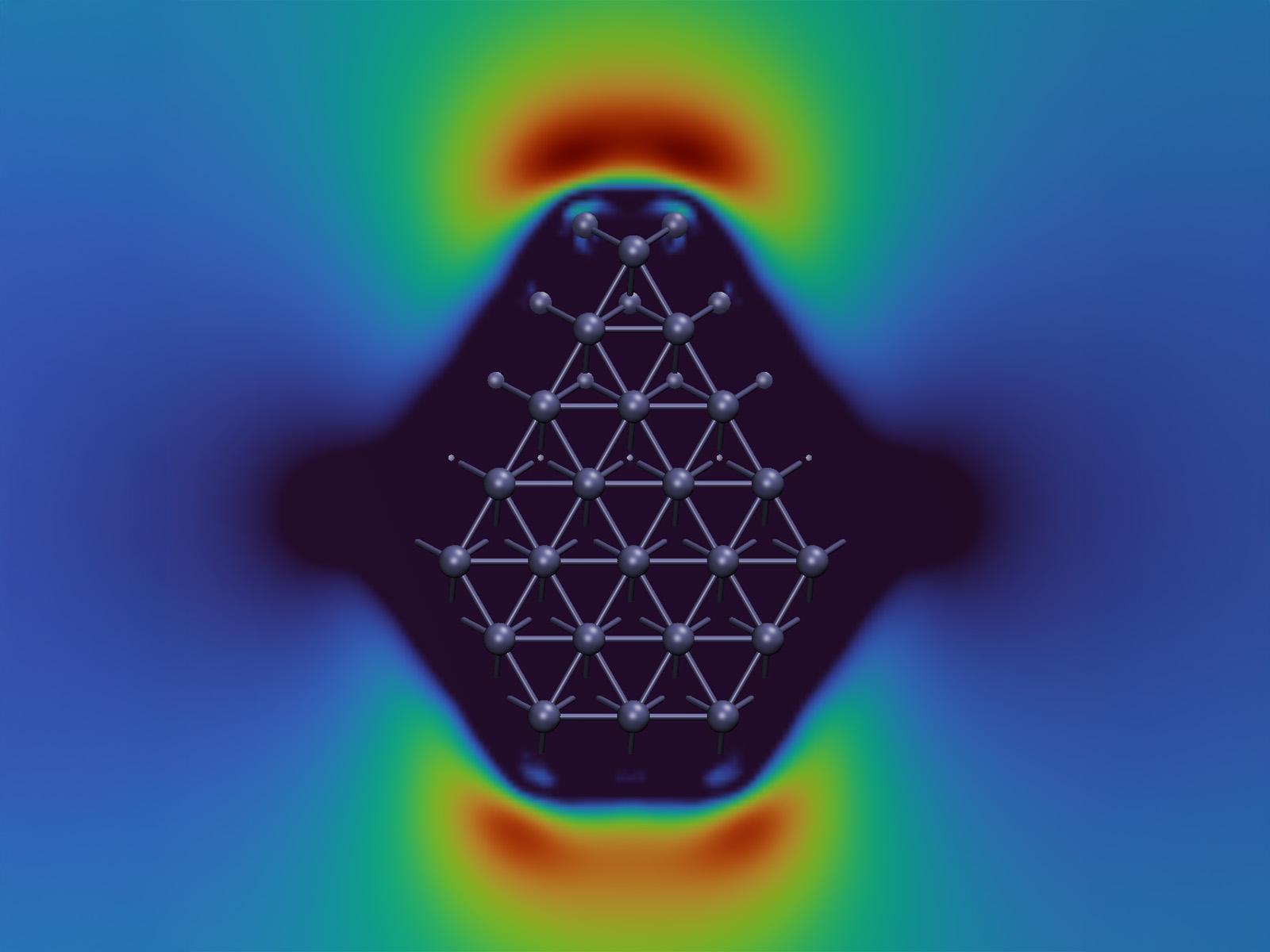
Exploiting shape- and material-dependent enhancement enables the tuning intrinsic and response local fields for catalysis, electrochemistry, plasmonics, and other field-driven chemical-physics phenomena.
(Image by Shawn Kathmann | Pacific Northwest National Laboratory)
<関連情報>
- https://www.pnnl.gov/publications/weak-electric-fields-can-profoundly-influence-chemical-physics-phenomena
- https://pubs.acs.org/doi/full/10.1021/acs.jpcc.5c04104
界面における電場 Electric Fields at Interfaces
Michael D. LaCount,Sten V. Lambeets,Daniel E. Perea,Tanya Prozorov,and Shawn M. Kathmann
The Journal of Physical Chemistry C Published July 17, 2025
DOI:https://doi.org/10.1021/acs.jpcc.5c04104
Abstract
Understanding how weak applied electric fields influence condensed phase and interfacial molecular processes is relevant to fundamental and applied sciences. Controlling interfacial fields holds the promise of exploiting chemical interactions at ever finer scales. But, before we can engineer fields to their ultimate ends, the intrinsic and response electric fields must be accurately characterized and quantified. In this Feature Article we provide an overview of the role of measurement and theory toward this goal. As a pedagogical example, we consider the important triple bond dissociation reaction N2 → N + N on the surface of a ruthenium nanoparticle with and without applied fields. Quantum mechanical (QM) calculations have been used to quantify the electric potentials, fields, and changes in orbital energetics are placed within the broader context of electron holography/tomography measurements and quantum calculations of the mean inner potentials of materials as functions of atomic number. The spatial resolution of the interfacial fields typically relevant to local chemical interactions is beyond the best currently available to researchers of high-resolution electron holography/tomography used to quantify these fields. We underscore that the intrinsic fields are many orders of magnitude greater the usual applied fields. We also discuss the lightning rod effect where the inducing field is amplified by a factor of 3 above the tip of a Ru nanoparticle. These considerations call for a reinterpretation of how weak applied fields can have such a profound influence on chemical physics phenomena.