2025-08-15 中国科学院(CAS)
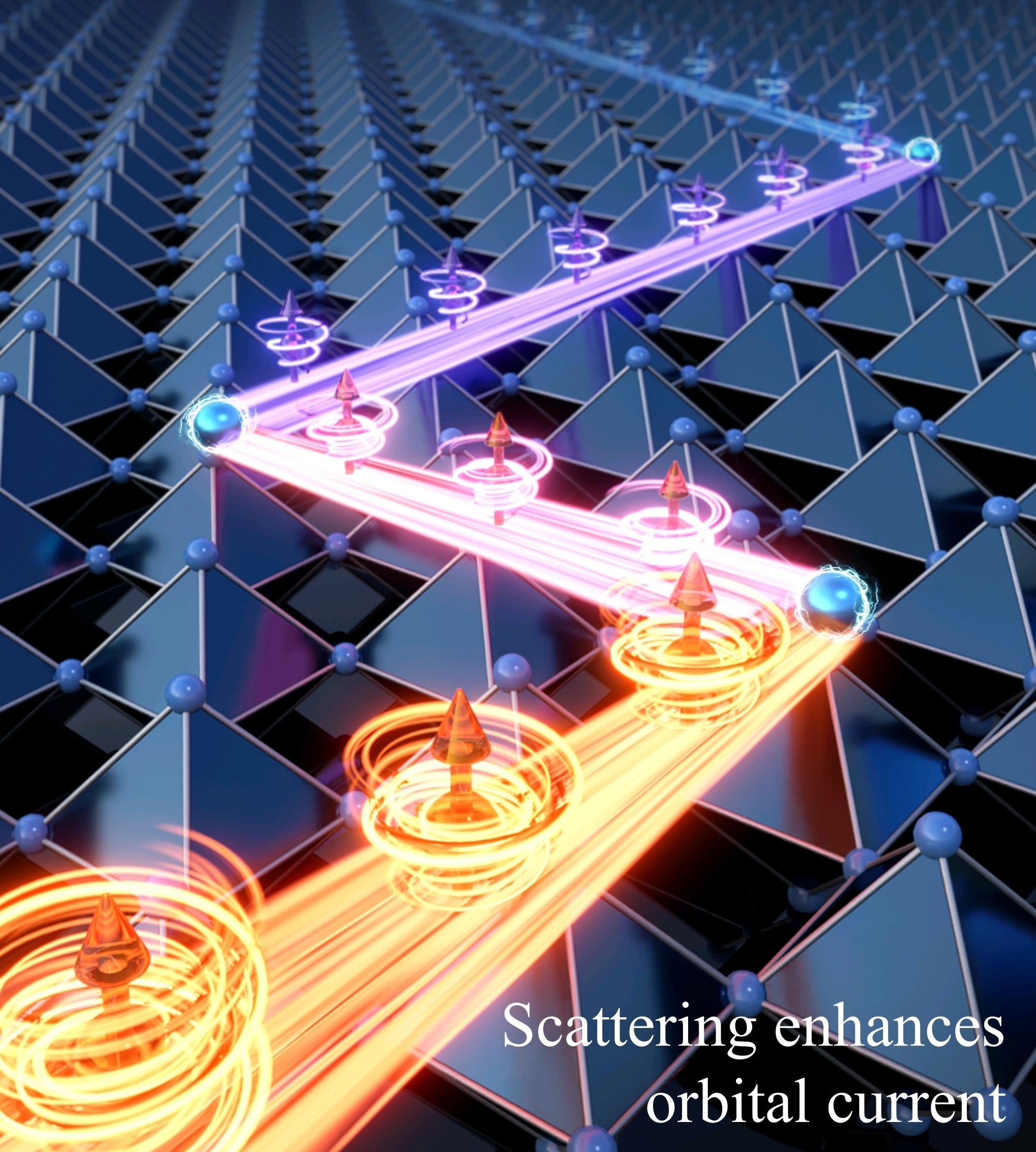 Paradoxical effect where scattering enhances orbital currents unlocks low-power high-performance spintronics. (Image by NIMTE)
<関連情報>
- https://english.cas.cn/newsroom/research_news/phys/202508/t20250815_1050505.shtml
- https://www.nature.com/articles/s41563-025-02326-3
軌道ホール効果の非伝統的なスケーリング Unconventional scaling of the orbital Hall effect
Siyang Peng,Xuan Zheng,Sheng Li,Bin Lao,Yamin Han,Zhaoliang Liao,Hongsheng Zheng,Yumeng Yang,Tianye Yu,Peitao Liu,Yan Sun,Xing-Qiu Chen,Shouzhong Peng,Weisheng Zhao,Run-Wei Li & Zhiming Wang
Nature Materials Published:15 August 2025
DOI:https://doi.org/10.1038/s41563-025-02326-3
Abstract
Orbital torque is a promising approach for electrically controlling magnetization in spintronic devices. However, unravelling the underlying mechanisms governing the orbital Hall effect (OHE), especially the role of extrinsic scattering and its scaling with conductivity (σxx), is crucial for realizing the full potential of orbital torque in energy-efficient spintronic devices. Here, using SrRuO3 as a model system, we discover an unconventional scaling of orbital Hall conductivity (σOH) with tunable σxx.σOH remains constant at high σxx but exhibits a striking enhancement as σxx decreases, contrasting with spin Hall effect suppression at low σxx. This behaviour underscores the Dyakonov–Perel-like orbital relaxation mechanism as key to unconventional OHE. Leveraging this scaling, we achieve enhanced orbital torque via concurrent increases in orbital Hall conductivity and orbital Hall angle, demonstrating threefold power reduction in spin–orbit torque switching with moderate σxx reduction. Our work highlights the dominant role of extrinsic disorder scattering in unconventional OHE and establishes a transformative paradigm for energy-efficient spintronics.