2025-08-12 ペンシルベニア州立大学 (Penn State)
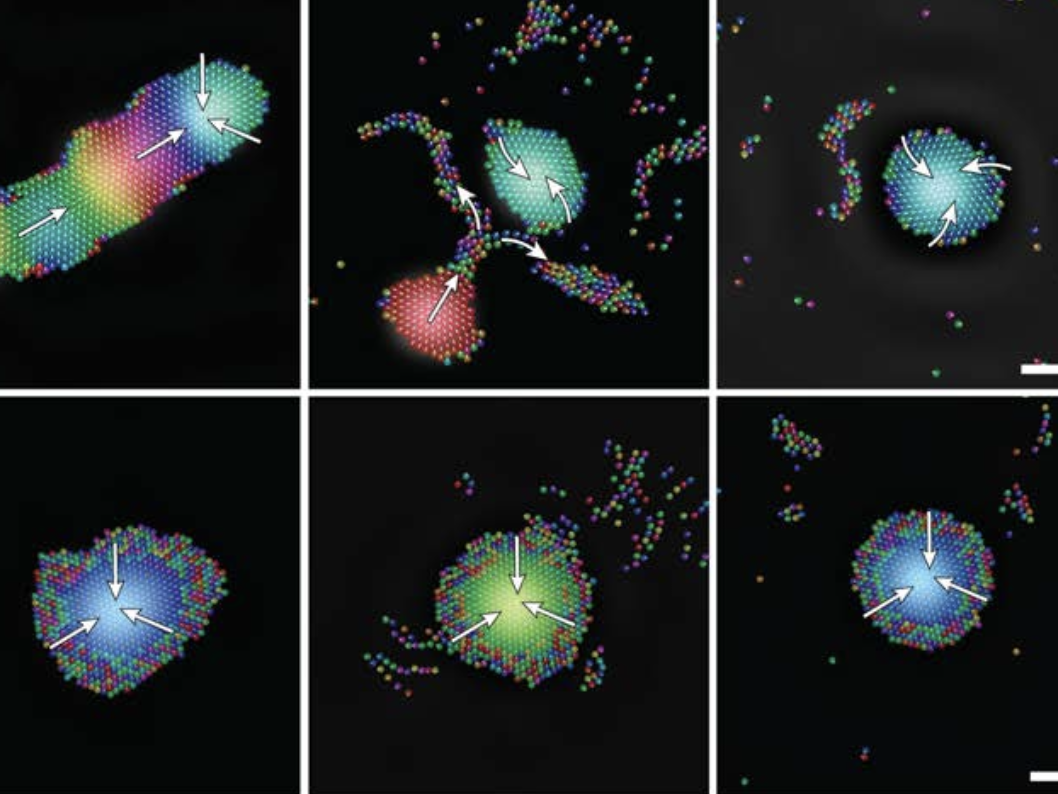
A new study led by Penn State researchers shows for the first time how sound waves could function as a means of controlling micro-sized robots. Credit: Igor Aronson / Penn State. Creative Commons
<関連情報>
- https://www.psu.edu/news/research/story/tiny-robots-use-sound-self-organize-intelligent-groups
- https://journals.aps.org/prx/abstract/10.1103/m1hl-d18s
音響信号が活性物質系における集団的知覚と制御を可能にする Acoustic Signaling Enables Collective Perception and Control in Active Matter Systems
Alexander Ziepke, Ivan Maryshev, Igor S. Aranson, and Erwin Frey
Physical Review X Published: 12 August, 2025
DOI: https://doi.org/10.1103/m1hl-d18s
Abstract
Emergent cooperative functionality in active matter systems plays a crucial role in various applications of active swarms, ranging from pollutant foraging and collective threat detection to tissue embolization. In nature, animals like bats and whales use acoustic signals to communicate and enhance their evolutionary competitiveness. Here, we show that information exchange by acoustic waves between active agents creates a large variety of multifunctional structures. In our realization of collective swarms, each unit is equipped with an acoustic emitter and a detector. The swarmers respond to the resulting acoustic field by adjusting their emission frequency and migrating toward the strongest signal. We find self-organized structures with different morphology, including snakelike self-propelled entities, localized aggregates, and spinning rings. These collective swarms exhibit emergent functionalities, such as phenotype robustness, collective decision making, and environmental sensing. For instance, the collectives show self-regeneration after strong distortion, allowing them to penetrate through narrow constrictions. Additionally, they exhibit a population-scale perception of reflecting objects and a collective response to acoustic control inputs. Our results provide insights into fundamental organization mechanisms in information-exchanging swarms. They may inspire design principles for technical implementations in the form of acoustically or electromagnetically communicating microrobotic swarms capable of performing complex tasks and concerting collective responses to external cues.