2025-08-11 テキサス A&M大学
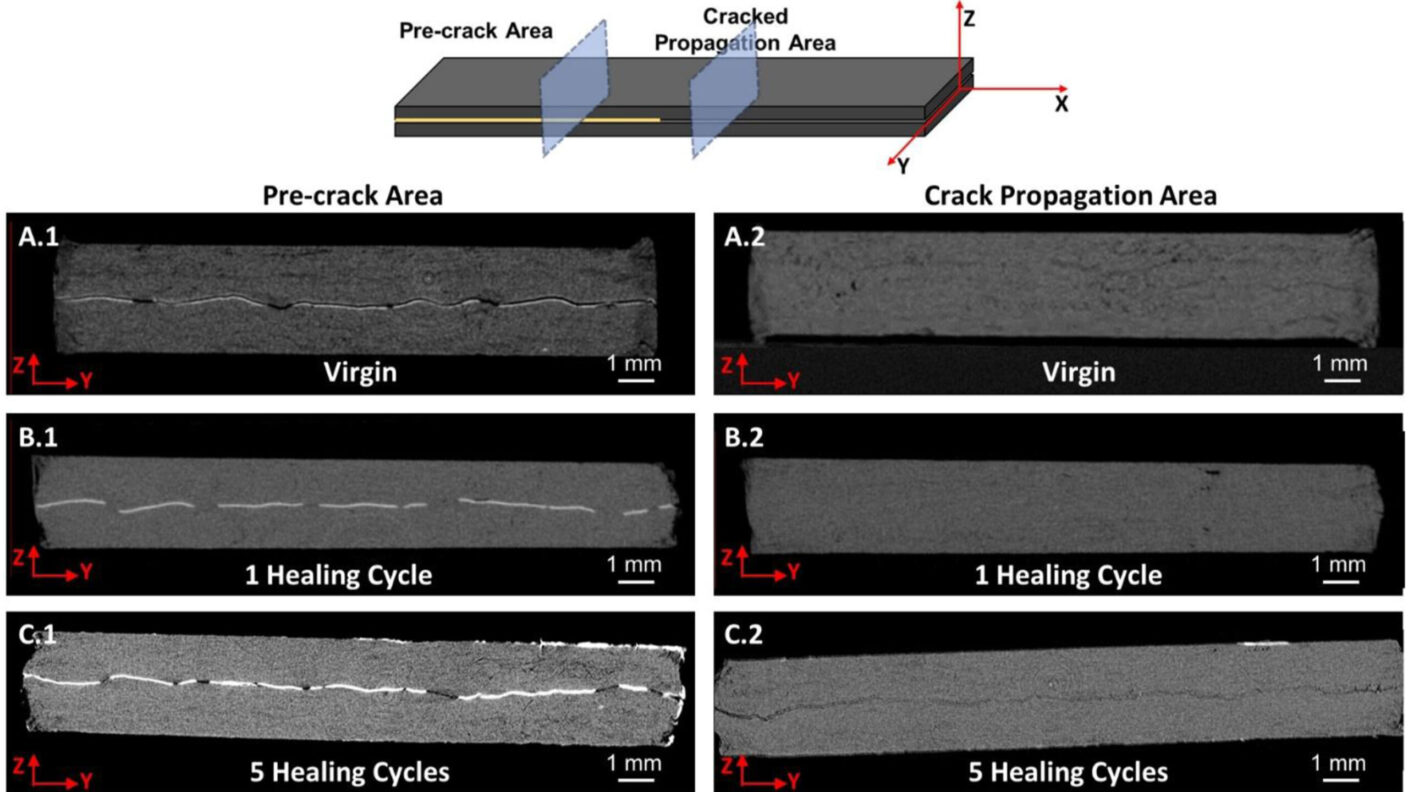
X-ray images of ATSP across five different damage-healing cycles. In the first cycle, the scans revealed that ATSP fully healed and recovered its shape and strength. By the fifth cycle, mechanical fatigue began to appear, though the durability and chemical stability were not affected.
Credit: Dr. Mohammad Naraghi/Texas A&M University. https://doi.org/10.1177/00219983251362394
<関連情報>
- https://stories.tamu.edu/news/2025/08/11/breakthrough-smart-plastic-self-healing-shape-shifting-and-stronger-than-steel/
- https://journals.sagepub.com/doi/10.1177/00219983251362394
- https://pubs.acs.org/doi/10.1021/acs.macromol.4c02376
ヴィトリマー炭素繊維強化ポリマー複合材料における内在的な自己修復機能の漸進的な劣化の原因を特定する Identifying the origin of intrinsic self-healing gradual decay in vitrimer carbon fiber reinforced polymer composites
Tanaya Mandal, Unal Ozten https://orcid.org/0000-0003-3846-4954, […], and Mohammad Naraghi
Journal of Composite Materials Published:July 18, 2025
DOI:https://doi.org/10.1177/00219983251362394
Abstract
The performance of materials degrades over time. One group of materials which stands out with their high maintenance costs is carbon fiber reinforced polymer (CFRP) composites. Vitrimers, an emerging class of self-healing thermosetting polymers can regain their properties upon damages via bond reformation. In this study, we evaluated self-healing in vitrimer composites subjected to multiple fracture-healing cycles. The study focused on a vitrimer with high thermal resistance (Aromatic thermosetting polyester – ATSP). To assess the self-healing, we performed Mode I fracture double cantilever beam test, followed by healing at 280°C for five cycles. The results demonstrated that there was complete healing after the first two cycles, with mode I fracture toughness of ∼300 J/m2, albeit with a gradual decline of healing after the third cycle, reaching to ∼80% healing efficiency after the 5th cycle. From scanning electron microscopy, optical microscopy, and micro-computed tomography X-ray imaging, surface and internal morphology of the vitrimer CFRPs closely resembled the virgin samples after two cycles. However, integrity of matrix and carbon fiber structure around crack was gradually depleted after the third cycle. Infrared spectroscopy ruled out material degradation. The performance decline in vitrimer composites was associated with the irreversible local mechanical damages which accumulated during multiple fractures and the limited chain diffusion in vitrimers. Hence, bond exchanges are more likely to occur between chains on one side of the crack rather than across the crack. The study outlines the advantages and limitations of exchangeable bonds in achieving high performance composites with intrinsic and sustained self-healing ability.
ガラス転移温度未満の共有結合適応ネットワークポリマーにおける形状記憶と疲労回復 Shape Memory and Fatigue Reversal in a Covalent Adaptive Network Polymer below Glass Transition Temperature
Louis O. Vaught,Mohammad Naraghi,Jacob L. Meyer,Andreas A. Polycarpou
Macromolecules Published: April 10, 2025
DOI:https://doi.org/10.1021/acs.macromol.4c02376
Abstract
Polymers with associative covalent adaptive networks, or vitrimers, can be characterized with a topology freezing temperature (Tv). This is a hypothetical transition point where covalent bond exchange reactions no longer impact the bulk material response. In this work, we present a family of vitrimers, aromatic thermosetting copolyester (ATSP), which has apparent bond exchange behavior substantially below the glass transition temperature (Tg). Traditional stress relaxation tests for Tv of this family predict a nonphysical temperature due to a slow secondary elastic deformation. A novel cyclical creep study is developed, which detects Tv by a shape memory effect and release of strain energy. Using this method, Tv is measured as the change in residual deformation when a tensile sample is relaxed. For three example material formulations, this approach suggests Tv to be 150, 155, and 160 °C, while the Tg are considerably higher, at 207, 233, and 245 °C, respectively. The presence of bond exchange below Tg is validated via a deep-cycle bending fatigue study with periodic notable healing operations at 160 °C. This healing behavior extends the fatigue life of the material from 160 cycles to over 500 cycles. Following a final healing operation, the material exhibits 108% of the target minimum strength for an undamaged sample (99 MPa), despite exceeding the unhealed fatigue life by over 300%. This demonstrates highly repeatable defect healing at a relatively low temperature, which could be leveraged to substantially extend the material service life under ideal conditions.