2025-08-04 森林総合研究所,北海道大学,北海道立総合研究機構,人間環境大学
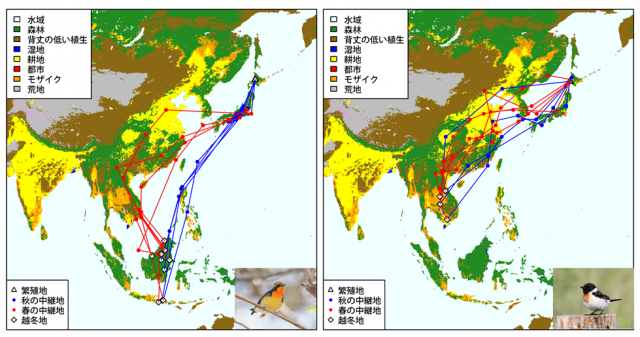
図1 キビタキ(左)とノビタキ(右)の渡り経路の推定結果
ノイズの大きなデータは図化には用いなかったため、キビタキの秋季は4個体、春季は7個体、ノビタキの秋季は4個体、春季は5個体のみのデータを図化しました。キビタキの春季の渡りはジオロケーターの電池切れのため、途中までしか追えませんでした。キビタキは越冬地や渡り中継地に森林地帯を、ノビタキは開放的な地域を主に利用していました。
<関連情報>
- https://www.ffpri.go.jp/press/2025/20250804/index.html
- https://www.ffpri.go.jp/press/2025/20250804/documents/20250804press.pdf
- https://link.springer.com/article/10.1007/s10336-025-02297-x
- https://zslpublications.onlinelibrary.wiley.com/doi/abs/10.1111/acv.70013
日本と東南アジアを結ぶ二種の鳴鳥の環状・同一の渡り経路 Loop vs. same route migrations of two songbird species between Japan and Southeast Asia
Yuichi Yamaura,Heiko Schmaljohann,Akira Unno,Kazuhiro Kawamura,Munehiro Kitazawa,Shigeho Sato,Daisuke Aoki,Yuji Okahisa & Masayuki Senzaki
Journal of Ornithology Published:27 May 2025
DOI:https://doi.org/10.1007/s10336-025-02297-x
Abstract
While many long-distance migratory birds are experiencing severe population declines, some species showed abundance increases and range expansions. Knowledge of migratory routes may provide key insights into these variations of population dynamics among species. In contrast to the Nearctic and Western Palearctic flyways, fewer migratory routes of songbird species in the East Asian–Australasian Flyway have been studied so far. In this study, we tracked the migratory routes of two songbird species, Narcissus Flycatcher (Ficedula narcissina) and Amur Stonechat (Saxicola stejnegeri), which breed in Hokkaido, northern Japan, using miniaturized light-level geolocators. As a control, we only color-ringed individuals from the same populations without deploying geolocators. We found no negative effects of carrying a geolocator throughout the year on the return rates to the breeding areas. Both species spent approximately 1.5–2.0 months migrating from Japan to Southeast Asia in autumn. Narcissus Flycatchers exhibited a clockwise loop migration between Japan and Southeast Asia by following an archipelago-based southern route in autumn, passing through the northern Philippines, to reach Borneo or eastern Java. They took a mainland route along the eastern Chinese coastline to return to southern Japan in spring. Amur Stonechats, in contrast, migrated between breeding grounds and Southeast Asian wintering grounds via China in both seasons. Season- and species-specific selection of migration routes may depend on evolutionary histories, different ecological requirements, and seasonal time constraints. Notably, stopover sites were found in both species at eastern Chinese coastal lines indicating their high biological significance in this flyway.
東南アジアの保全に対する支払い意志額を左右する要因:日本人にとっては視覚情報よりも自然との心理的つながりが重要 Drivers of Willingness to Pay for Conservation in Southeast Asia: Nature Relatedness Over Visual Cues Among Japanese People
Yuichi Yamaura, Yasushi Shoji, Heiko Schmaljohann, Akira Unno, Richard T. Yao, Ding Li Yong, Kazuhiro Kawamura, Munehiro Kitazawa, Shigeho Sato, Daisuke Aoki, Yuji Okahisa …
Animal Conservation Published: 04 April 2025
DOI:https://doi.org/10.1111/acv.70013
ABSTRACT
Many long-distance migratory birds are experiencing global declines, creating an urgent need for conservation actions. Engaging public commitment to their conservation is therefore crucial. However, this task is challenging as the social interest diminishes as the geographic distance to conservation issues increases. One potential solution is to reduce people’s psychological distance by providing visual information that illustrates how avian migratory routes connect countries and how conservation organizations implement conservation measures in distant countries. In this study, we conducted a discrete choice experiment with the Japanese public (n = 1081) to estimate their willingness to pay (WTP) for conservation measures aimed at improving and protecting the wintering habitats of migratory birds in Southeast Asia (i.e., establishing wetland/forest nature reserves and implementing environmentally friendly farming/forestry). We tested the impact on WTP of showing respondents avian migratory routes and photographs of activities undertaken by conservation organizations in Southeast Asia. Contrary to predictions, showing the evidence-based migratory routes connecting Japan and Southeast Asia had limited effects on the WTP of the Japanese public for conservation measures in Southeast Asia. Surprisingly, showing photographs of activities undertaken by conservation organizations in Southeast Asia had slightly negative impacts on WTP. Instead, WTP was strongly linked to subjective connection with nature (nature relatedness), with those exhibiting a stronger nature relatedness showing higher WTP. People showed higher WTP to establish nature reserves in Southeast Asia than to implement environmentally friendly farming/forestry in Southeast Asia, and there were weak negative interactions between implementing nature-reserve establishment and environmentally friendly farming/forestry simultaneously. These findings suggest that providing visual information alone may not be effective to foster social support for conservation measures in distant countries. Rather, approaches that cultivate the connection with nature—such as environmental education, residential camps, and local nature experiences—are needed, ideally beginning from a young age.