2025-07-29 トロント大学(U of T)
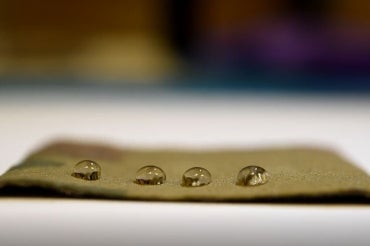
This piece of fabric is coated with a new non-stick material made via a technique called nanoscale fletching, developed by researchers in the department of mechanical and industrial engineering in U of T’s Faculty of Applied Science & Engineering (photo by Samuel Au)
<関連情報>
- https://www.utoronto.ca/news/u-t-researchers-develop-safer-alternative-non-stick-coatings
- https://www.nature.com/articles/s41467-025-62119-9
液体状のポリジメチルシロキサンに単一のパーフルオロカーボンをナノスケールで付着させることで、持続可能な油撥水性を実現 Nanoscale fletching of liquid-like polydimethylsiloxane with single perfluorocarbons enables sustainable oil-repellency
Samuel Au,Jeremy R. Gauthier,Boran Kumral,Tobin Filleter,Scott Mabury & Kevin Golovin
Nature Communications Published:23 July 2025
DOI:https://doi.org/10.1038/s41467-025-62119-9
Abstract
Oil repellency is essential for enabling self-cleaning, anti-soiling and stain-repelling properties, which has broad application in industries liked textiles, healthcare and electronics. While per-and-polyfluoroalkyl substances (PFAS) exhibits strong oleophobicity, their environmental and health risks have led to prohibition on long-chain PFAS ( ≥ C8) and restriction on short-chain PFAS (C4, C6). However, there are few alternative materials demonstrating comparable oil repellency. Here, we introduce a novel method to fletch polydimethylsiloxane (PDMS) brushes with ultrashort PFAS (singe -CF3, the least toxic PFAS), achieving oil repellency similar to short-chain PFAS while drastically reducing the fluorine content. This work highlights that liquid-like molecular design, rather than chain length, can enable sustainable oil repellency, facilitating a smoother transition away from PFAS reliance.