2025-07-18 中国科学院(CAS)
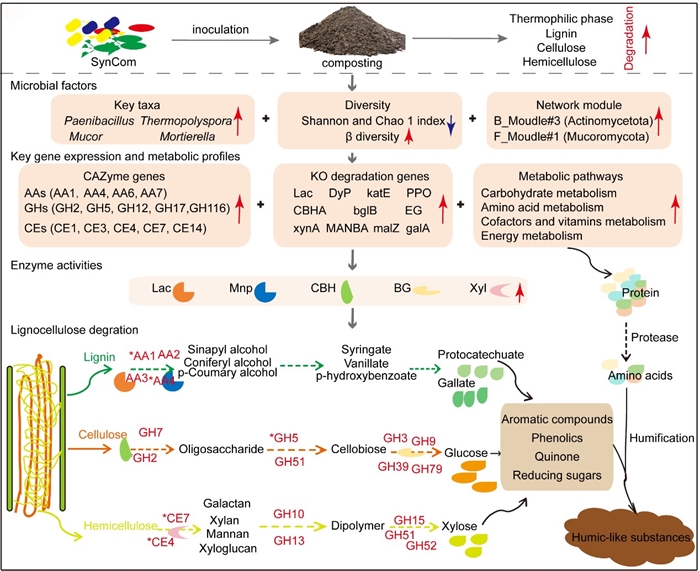
Mechanisms of synthetic microbial community inoculation in enhancing lignocellulose degradation during the thermophilic phase of composting (Image by CHEN Shuangshuang)
<関連情報>
- https://english.cas.cn/newsroom/research_news/earth/202507/t20250721_1047703.shtml
- https://www.sciencedirect.com/science/article/abs/pii/S1385894725066859
- https://www.sciencedirect.com/science/article/abs/pii/S0960852425000343
- https://www.mdpi.com/2076-2607/13/1/148
堆肥化好熱相におけるリグノセルロース分解を促進する合成微生物群集:メタゲノムおよび代謝経路に関する知見 Synthetic microbial community enhances lignocellulose degradation at the composting thermophilic phase: metagenomic and metabolic pathway insights
Shuangshuang Chen, Qiumei Liu, Dejun Li
Chemical Engineering Journal Available online: 9 July 2025
DOI:https://doi.org/10.1016/j.cej.2025.165847
Highlights
- SynCom inoculation stimulates lignocellulose degradation at the thermophilic phase.
- SynCom inoculation changes microbial composition, diversity and functions.
- SynCom inoculation increases the abundance of functional genes.
- SynCom enhances carbohydrate, amino acid, cofactor/vitamin, and energy metabolism.
Abstract
Lignocellulose degradation is critical for improving compost quality. While synthetic microbial community (SynCom) inoculation has proven effective in promoting lignocellulose degradation during composting, the underlying mechanisms remain poorly understood. The present study was aimed to explore the mechanisms underlying effect of SynCom inoculation on lignocellulose degradation by comprehensively analyzing microbial communities, functional genes and metabolic profiles during the thermophilic stage of composting with mulberry branch and cattle manure. SynCom inoculation significantly reduced lignin, cellulose, and hemicellulose contents by 13.1 %, 14.7 %, and 9.2 %, respectively, compared to the control at the thermophilic phase, accompanied by significant (p < 0.05) increases in the activities of key lignocellulolytic enzymes, i.e., laccase (13.3 %), manganese peroxidase (8.0 %), cellobiohydrolase (43.1 %), β-glucosidase (6.6 %), and xylanase (85.4 %). LEfSe and network analyses revealed that SynCom-driven microbial community restructuring enriched keystone taxa (Sphaerobacter, Paenibacillus, Thermopolyspora, Mucor, and Mortierella), with bacterial Actinomycetota and fungal Mucoromycota modules exhibiting strong negative correlations with residual lignocellulose content. SynCom inoculation significantly increased the relative abundance of CAZyme genes (e.g. GH12, CE4, AA4) and enhanced metabolic pathways, including carbohydrate metabolism, amino acid metabolism, cofactor and vitamin metabolism, and energy metabolism. Random forest analysis identified microbial key taxa (bacteria: 19.8 %, fungi: 22.1 %), enzyme activities (ligninase: 10.2 %, cellulase and hemicellulase: 23.7 %), and carbohydrate-active enzyme abundance (23.1 %) as the primary drivers of degradation. These findings demonstrate that SynCom inoculation accelerates lignocellulose degradation by reshaping the microbial community’s genetic potential and metabolic functions, offering a promising strategy to optimize organic waste valorization and sustainable fertilizer production.
合成微生物群集は、菌類群集を集合させることにより、堆肥化中のリグノセルロース分解を促進する Synthetic microbial community enhances lignocellulose degradation during composting by assembling fungal communities
Qiumei Liu, Zhouling Xie, Siyu Tang, Qingquan Xie, Xunyang He, Dejun Li
Bioresource Technology Available online 13 January 2025
DOI:https://doi.org/10.1016/j.biortech.2025.132068
Highlights
- SynComs enhanced cellulose and hemicellulose degradation by 26.2% and 14.3%.
- OTU10 is critical in fungal diversity increase and lignocellulose degradation.
- The altered fungal community stimulated the fungal function of secreting hydrolase.
Abstract
Inoculating synthetic microbial community (SynCom) has been proposed as an eco-friendly approach for lignocellulose degradation in composting to enhance organic fertilizer quality. However, the mechanisms responsible for SynCom-regulated lignocellulose degradation during composting remain unclear. Here the SynCom inoculation decreased cellulose and hemicellulose contents by 26.2% and 14.3%, respectively, at the mature phase, while increasing endoglucanase, exoglucanase, and β-glucosidase activities significantly. SynCom inoculation increased the abundance of Cephaliophoras and Thermomyces at the mesophilic phase, Sordariomycetes at the thermophilic phase, and Thermomyces, Acremonium, Aspergillus, and Sordariomycetes at the mature phase, as well as increased the abundance of numerous Operational Taxonomic Units (OTUs), with OTU10 (Hydropisphaera) being responsible for lignocellulose degradation. The altered fungal community stimulated functions of the wood saprotroph, undefined saprotroph, and litter saprotroph were responsible for lignocellulose degradation via changing microbial community. The results suggest that SynCom inoculation effectively stimulate lignocellulose degradation, so that benefits quality improvement of organic fertilizer.
合成微生物群集は根圏微生物群集を制御することによりペッパーの成長と根の形態を促進する Synthetic Microbial Communities Enhance Pepper Growth and Root Morphology by Regulating Rhizosphere Microbial Communities
Tian You,Qiumei Liu,Meng Chen,Siyu Tang,Lijun Ou and Dejun Li
Microorganisms Published: 13 January 2025
DOI:https://doi.org/10.3390/microorganisms13010148
Abstract
Synthetic microbial community (SynCom) application is efficient in promoting crop yield and soil health. However, few studies have been conducted to enhance pepper growth via modulating rhizosphere microbial communities by SynCom application. This study aimed to investigate how SynCom inoculation at the seedling stage impacts pepper growth by modulating the rhizosphere microbiome using high-throughput sequencing technology. SynCom inoculation significantly increased shoot height, stem diameter, fresh weight, dry weight, chlorophyll content, leaf number, root vigor, root tips, total root length, and root-specific surface area of pepper by 20.9%, 36.33%, 68.84%, 64.34%, 29.65%, 27.78%, 117.42%, 35.4%, 21.52%, and 39.76%, respectively, relative to the control. The Chao index of the rhizosphere microbial community and Bray–Curtis dissimilarity of the fungal community significantly increased, while Bray–Curtis dissimilarity of the bacterial community significantly decreased by SynCom inoculation. The abundances of key taxa such as Scedosporium, Sordariomycetes, Pseudarthrobacter, norankSBR1031, and norankA4b significantly increased with SynCom inoculation, and positively correlated with indices of pepper growth. Our findings suggest that SynCom inoculation can effectively enhance pepper growth and regulate root morphology by regulating rhizosphere microbial communities and increasing key taxa abundance like Sordariomycetes and Pseudarthrobacter, thereby benefiting nutrient acquisition, resistance improvement, and pathogen resistance of crops to ensure sustainability.