
2025-07-21 カリフォルニア大学サンタバーバラ校(UCSB)
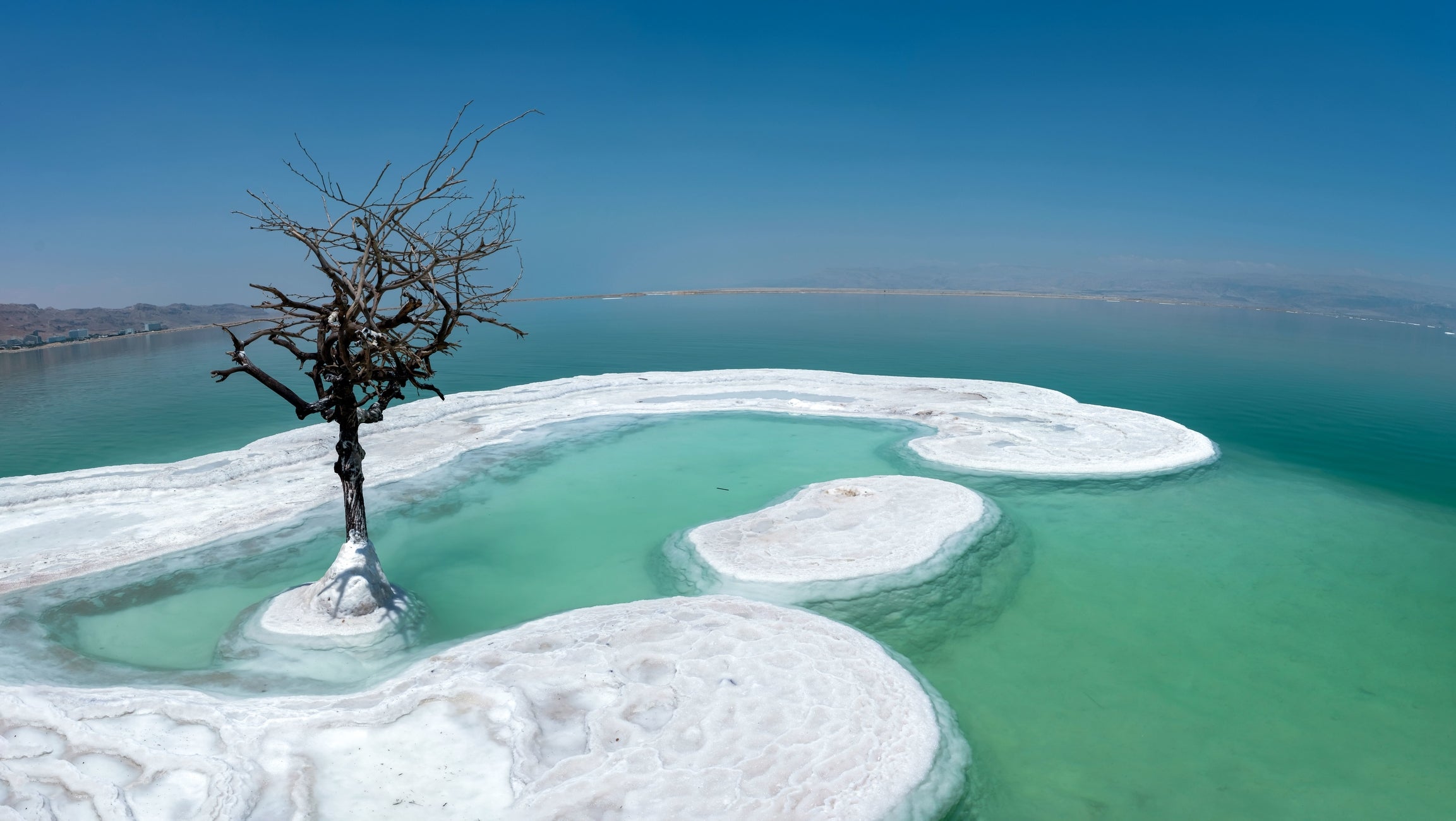
<関連情報>
- https://news.ucsb.edu/2025/021963/dead-seas-salt-giants-offer-rare-glimpse-earths-geological-past
- https://www.annualreviews.org/content/journals/10.1146/annurev-fluid-031424-101119
- https://agupubs.onlinelibrary.wiley.com/doi/10.1029/2019WR024818
死海の流体力学 Fluid Mechanics of the Dead Sea
Eckart Meiburg and Nadav G. Lensky
Annual Review of Fluid Mechanics Published:September 11, 2024
DOI:https://doi.org/10.1146/annurev-fluid-031424-101119
ABSTRACT
The environmental setting of the Dead Sea combines several aspects whose interplay creates flow phenomena and transport processes that cannot be observed anywhere else on Earth. As a terminal lake with a rapidly declining surface level, the Dead Sea has a salinity that is close to saturation, so that the buoyancy-driven flows common in lakes are coupled to precipitation and dissolution, and large amounts of salt are being deposited year-round. The Dead Sea is the only hypersaline lake deep enough to form a thermohaline stratification during the summer, which gives rise to descending supersaturated dissolved-salt fingers that precipitate halite particles. In contrast, during the winter the entire supersaturated, well-mixed water column produces halite. The rapid lake level decline of O(1 m/year) exposes vast areas of newly formed beach every year, which exhibit deep incisions from streams. Taken together, these phenomena provide insight into the enigmatic salt giants observed in the Earth’s geological record and offer lessons regarding the stability, erosion, and protection of arid coastlines under sea level change.
死海における二重拡散性塩指からのハライト析出: 数値シミュレーション Halite Precipitation From Double-Diffusive Salt Fingers in the Dead Sea: Numerical Simulations
Raphael Ouillon, Nadav G. Lensky, Vladimir Lyakhovsky, Ali Arnon, Eckart Meiburg
Water Resources Research Published: 03 May 2019
DOI:https://doi.org/10.1029/2019WR024818
Abstract
We employ direct numerical simulations in order to analyze the role of double-diffusive salt fingering in halite precipitation from hypersaline lakes. Guided by field observations from the Dead Sea, which represents the only modern deep stratified lake that precipitates halite under hydrological crisis, we consider a saturated layer of warm, salty brine (epilimnion) overlying a layer of colder, less salty brine (hypolimnion) that is also saturated. The double-diffusive instability originating in the metalimnion gives rise to an asymmetrical pattern of less salty ascending fingers, accompanied by descending salt fingers that lose heat as they propagate through the metalimnion. The net result is a strong, downward salinity flux that leads to the undersaturation of the epilimnion, while the hypolimnion becomes oversaturated and precipitates halite. These interfacial processes within deep, hypersaline water columns in warm and dry regions suggest a potential route toward the formation of thick halite layers found in the geological record.
Key Points
- Guided by Dead Sea observations, we simulate double-diffusive salt fingering in saturated, hypersaline water columns
- Salt fingering results in the undersaturation of the epilimnion, as well as halite precipitation in the hypolimnion
- The observed interfacial processes suggest a route toward the formation of thick halite layers found in the geological record


