2025-07-17 東京大学
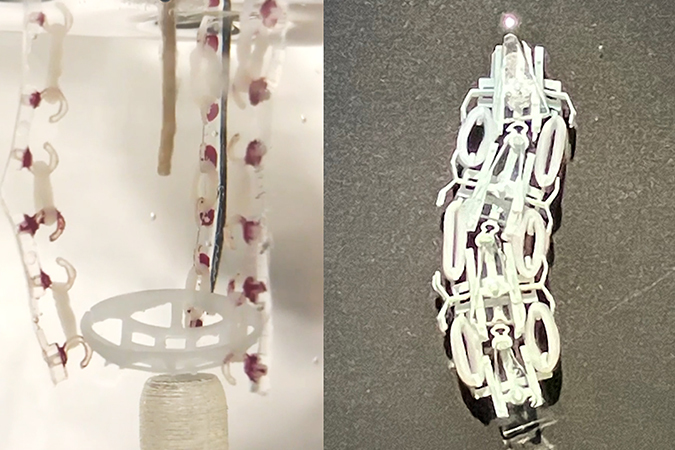
筋肉のリングで動く多関節グリッパ(左)、ヘビ型ロボット(右)
<関連情報>
- https://www.u-tokyo.ac.jp/focus/ja/press/z0114_00075.html
- https://www.u-tokyo.ac.jp/content/400267687.pdf
- https://www.science.org/doi/10.1126/sciadv.adu9962
収縮力を強化した筋肉リングを動力源とする破傷風駆動バイオハイブリッド多関節ロボット Tetanus-driven biohybrid multijoint robots powered by muscle rings with enhanced contractile force
Tomohiro Morita, Minghao Nie, and Shoji Takeuchi
Science Advances Published:16 Jul 2025
DOI:https://doi.org/10.1126/sciadv.adu9962
Abstract
Biohybrid actuators using muscle rings have been limited to twitching movements and are unsuitable for sustained contractile force applications. In this study, we developed muscle rings capable of generating high contractile forces under tetanus stimulation. By enhancing the rigidity of pillar-shaped supports and increasing myoblast density through reduced extracellular matrix, we promoted the formation of dense, well-aligned muscle fiber bundles. The optimized muscle rings exhibited higher contractile forces compared to traditional methods. Integrating these muscle rings with C-shaped anchors efficiently converted contractile force into bending motion. We demonstrated the application of these muscle rings in gripper- and slither-type biohybrid robots, achieving large deformation and undulatory movement. This work advances biohybrid robotics by enabling sophisticated movements requiring continuous and powerful muscle contractions.