2026-11-09 カリフォルニア大学ロサンゼルス校(UCLA)
米国カリフォルニア大学ロサンゼルス校(UCLA)を中心とする国際研究チームは、約1,000光年離れた恒星系で、観測中に恒星面通過(トランジット)が消失した初めての惑星「TOI-2535 b」を発見し、その原因が隣接する未知の惑星との重力相互作用にあることを明らかにした。TOI-2535 bは恒星の極めて近くを8.25日周期で公転するホットジュピターで、NASAの系外惑星探査衛星TESSによる2019~2026年の観測から確認された。当初、惑星のトランジットは観測されていたが、通過時刻が最大6時間ずれるとともに、通過時間と明るさの変化が次第に小さくなり、2026年には観測されなくなった。研究チームは、未発見の隣接惑星との重力相互作用によって両惑星の公転軌道が歳差運動を起こし、地球から見た軌道の傾きが変化したと結論づけた。本成果は、ホットジュピターの形成・移動過程や複数惑星系の力学的進化を理解する手掛かりとなる。
NASA/ESA
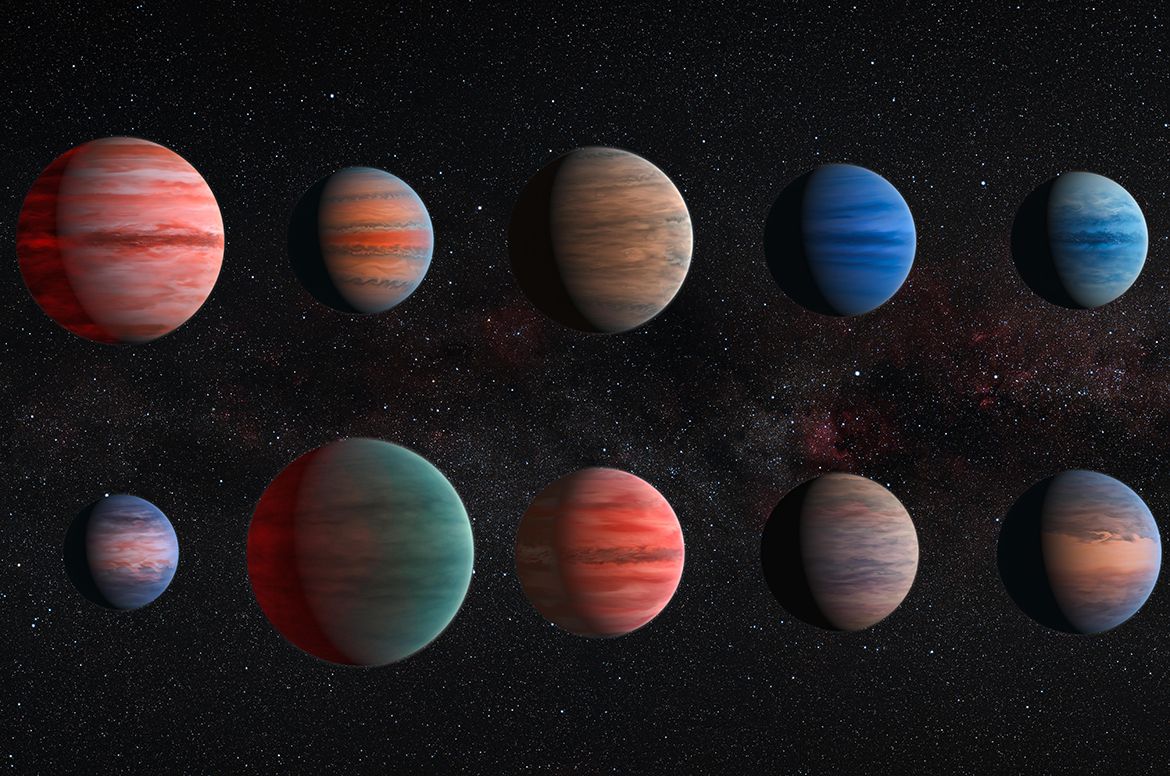
Above: An artist’s impression of the 10 hot Jupiter exoplanets studied using the Hubble and Spitzer space telescopes. Top row, from left: WASP-12b, WASP-6b, WASP-31b, WASP-39b and HD 189733. Bottom row, from left: HAT-P-12b, WASP-17b, WASP-19b, HAT-P-1b and HD 209458b.
<関連情報>
- https://newsroom.ucla.edu/releases/first-known-disappearing-planet-neighbor-wobble-like-top
- https://iopscience.iop.org/article/10.3847/2041-8213/aeb4a4
TESSの消失劇:TOI2535 bの消えゆく通過 A TESS Disappearing Act: The Vanishing Transits of TOI-2535 b
Samuel W. Yee, Erik A. Petigura, Rafael Brahm, Karen A. Collins, Gregor Srdoc, David W. Latham, Allyson Bieryla, Victoria DiTomasso, Thomas Henning, Andrés Jordán,…
The Astrophysical Journal Letters Published: 2026 November 9
DOI:10.3847/2041-8213/aeb4a4
Tii-summary
系外惑星が恒星の前を通過するトランジット現象は、惑星の軌道と観測者の視線が一致することで生じる。本研究では、NASAのトランジット系外惑星探索衛星(TESS)による約7年間の測光観測から、ホットジュピターTOI-2535 bのトランジットが徐々に恒星の視野から外れ、最終的に消失する過程を初めて直接確認した。トランジットの軌道位置を示すインパクトパラメータは年間0.16の速度で変化し、トランジット時刻にも最大約6時間のずれが認められた。さらに、トランジット時刻・継続時間の変動とNEID分光器による視線速度データを統合して解析した結果、TOI-2535 bの近傍に、相互に約5度以上傾いた軌道を持つ別の惑星が存在する可能性が示された。この天体は土星質量以上と推定され、重力相互作用によって惑星軌道面に歳差運動を引き起こし、トランジットを観測できなくしたと考えられる。本成果は、惑星間相互作用による軌道進化を人間の観測可能な時間尺度で捉えた重要な事例である。
Planetary transits occur when a planet’s orbit is favorably aligned with an observer’s line of sight. In this study, approximately seven years of photometric observations from NASA’s Transiting Exoplanet Survey Satellite (TESS) revealed the first direct observation of a planet orbiting a single star whose transits gradually disappeared. The hot Jupiter TOI-2535 b moved progressively across its host star’s disk and eventually ceased to transit. Its impact parameter changed at a rate of 0.16 per year, while transit timing deviations reached approximately six hours. By combining transit timing and duration variations with radial velocity measurements obtained using the NEID spectrograph, the researchers identified evidence for a nearby planetary companion with a mutually inclined orbit of at least approximately 5 degrees. The companion is estimated to have a mass comparable to or greater than Saturn’s. Its gravitational influence likely drives the precession of the planetary orbital planes, causing TOI-2535 b to move out of the observer’s line of sight. This discovery provides an unusually clear example of planet-planet interactions driving orbital evolution on human-observable timescales.
Planetary transits occur when a planet’s orbit is favorably aligned with an observer’s line of sight. In this study, approximately seven years of photometric observations from NASA’s Transiting Exoplanet Survey Satellite (TESS) revealed the first direct observation of a planet orbiting a single star whose transits gradually disappeared. The hot Jupiter TOI-2535 b moved progressively across its host star’s disk and eventually ceased to transit. Its impact parameter changed at a rate of 0.16 per year, while transit timing deviations reached approximately six hours. By combining transit timing and duration variations with radial velocity measurements obtained using the NEID spectrograph, the researchers identified evidence for a nearby planetary companion with a mutually inclined orbit of at least approximately 5 degrees. The companion is estimated to have a mass comparable to or greater than Saturn’s. Its gravitational influence likely drives the precession of the planetary orbital planes, causing TOI-2535 b to move out of the observer’s line of sight. This discovery provides an unusually clear example of planet-planet interactions driving orbital evolution on human-observable timescales.
出典:The Astrophysical Journal Letters, 1011, L60 (2026)。論文の公開抄録および書誌情報に基づく要約。