2026-08-03 スイス連邦工科大学ローザンヌ校(EPFL)
<関連情報>
- https://actu.epfl.ch/news/a-tiny-pore-identifies-cyanobacteria-toxins-in-lak/
- https://pubs.acs.org/ancac3/article/doi/10.1021/acsnano.6c05413/5237658/Sub-Nanomolar-Detection-and-Discrimination-of
エアロリシンナノポアを用いたマイクロシスチン同族体のサブナノモル濃度での検出および識別 Sub-Nanomolar Detection and Discrimination of Microcystin Congeners Using Aerolysin Nanopores
Alissa Agerova;Juan Francisco Bada Juarez;Louis W. Perrin;Luciano A. Abriata;Maria J. Marcaida;Anna Carratalà;Nora Selmani;Stéphanie Barbier;Fereidoun Khajehnouri;Giordano Vassalli;Elisabeth M. L. Janssen;Chan Cao;Tamar Kohn;Matteo Dal Peraro
ACS Nano Published:July 31, 2026
DOI:https://doi.org/10.1021/acsnano.6c05413
Abstract
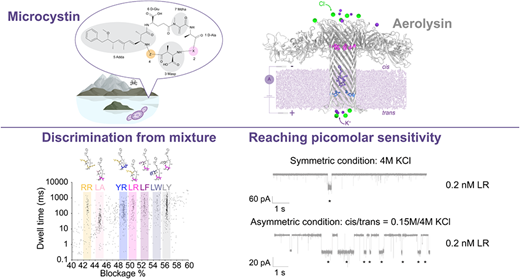
Climate-driven disruptions in aquatic ecosystems are amplifying cyanotoxin production, threatening drinking and recreational water safety. Monitoring of these toxins is challenged by requirements of the low μg/L detection limits and structural diversity. Here, we employ aerolysin nanopores to distinguish seven of the most prevalent microcystin congeners, both individually and in mixtures, at environmentally relevant concentrations. Importantly, we showed that aerolysin enables the detection of microcystins in spiked and real contaminated lake water samples at concentrations below the World Health Organization’s intervention thresholds, reaching picomolar sensitivity. Moreover, combining experiments and molecular dynamics simulations, we further investigated the microcystin sensing mechanism, suggesting that the ionic current blockage is primarily governed by K238 in aerolysin, while dwell time is regulated by the R220 constriction site. Our results support the use of nanopore sensing technology for real-time monitoring of microcystins in drinking water sources and surface waters.