2026-07-31 中国科学院(CAS)
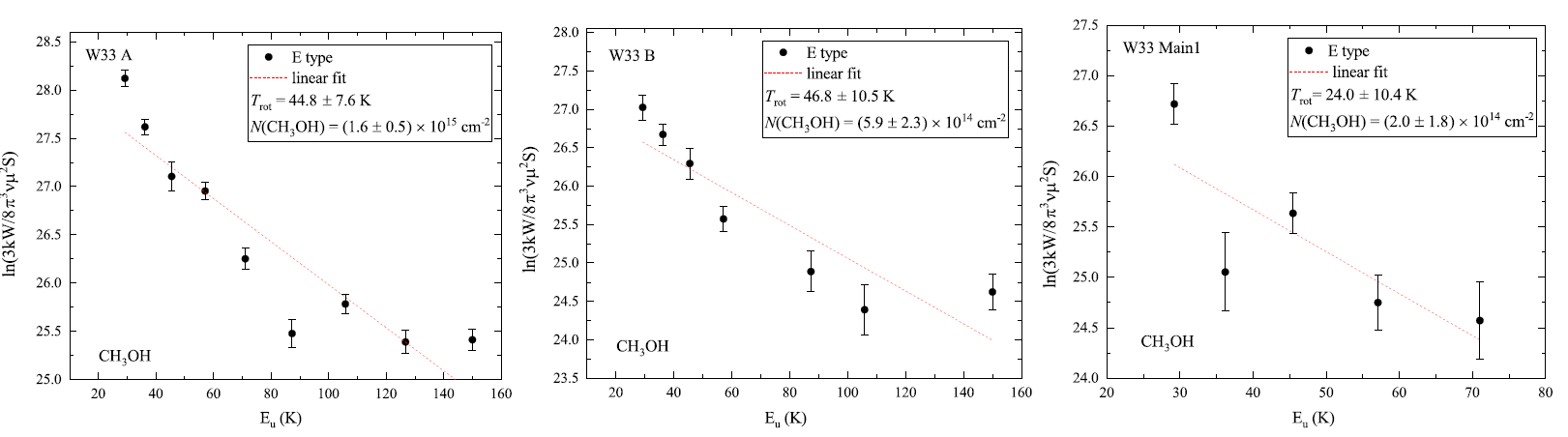
Rotation diagrams for the inverted lines of CH3OH. (Image by XAO)
<関連情報>
- https://english.cas.cn/newsroom/research-news/202607/t20260731_1186803.shtml
- https://www.aanda.org/articles/aa/full_html/2026/07/aa58605-25/aa58605-25.html
W33領域の1.3cmスペクトル線研究 A 1.3cm spectral line study of the W33 region
Kadirya Tursun, Christian Henkel, Jarken Esimbek, Gang Wu,, Dalei Li, Xindi Tang,, Jianjun Zhou, Thomas L. Wilson, Friedrich Wyrowski, Rainer Mauersberger, Katharina Immer,, Benjamin Winkel, Yuxin He, Dongdong Zhou, Yingxiu Ma, Andrey M. Sobolev,, Toktarkhan Komesh and Hailiang Shen
Astronomy & Astrophysics Published:08 July 2026
DOI:https://doi.org/10.1051/0004-6361/202558605
Abstract
At a distance of 2.4 kpc W33 is one of the most prolific sources of molecular line emission, and it is an excellent research target for a centimeter spectral line search. We carried out a 1.3 cm spectral line survey in the frequency range 18–26 GHz. The lines we identified include 44 radio recombination lines (RRLs) and 24 molecular lines, excluding transitions from the main isotopolog of NH3. The RRLs are associated with the ionized gas from W33 Main. Intensity ratios between RRL pairs with varying differences in the principal quantum number η (i.e., Δn) from the same element at adjacent frequencies agree with ratios expected under conditions of local thermodynamical equilibrium. In spite of a resulting helium-to-hydrogen abundance ratio (equal emitting volumes assumed) of (10.7±1.8)%, which is consistent with expectations, helium shows broader turbulent line widths than hydrogen. The difference amounts to a few kilometers per second, hinting that the spatial distributions are slightly different. The molecular lines are attributed to nine different species (CH3OH HC3N SiS, c-C3H2, CH3CN NH2D, HNCO, H2O and CCS). Rotation temperatures and column densities were derived from CH3OH transitions using rotational temperature diagram analysis. Maser emission produced by water vapor and methanol have been observed in W33 Main, W33 A, and W33 B. Our survey discovered a CH3OH (102,8–101,9 E) maser in W33 Main. Toward W33 B1, the fractionated deuterium-to-hydrogen ratio (D/H) deduced from para-NH2D/NH3 is estimated to be ≲(1.0 ± 0.2)×10−3. For the other molecular W33-hotspots, 3σ upper limits are (5.0 ± 0.4)×10−3. At linear scales of (0.5 pc), fractional abundances and excitation temperatures do not reach values close to those in well-established hot cores, but higher-resolution measurements may alter this picture.