2026-05-12 インペリアル・カレッジ・ロンドン(ICL)
<関連情報>
- https://www.imperial.ac.uk/news/articles/2026/major-survey-of-london-tap-water-shows-forever-chemicals-within-safe-limits/
- https://pubs.rsc.org/en/content/articlelanding/2026/va/d6va00076b
都市水道水におけるPFASの発生:英国ロンドンにおける参加型ケーススタディ Occurrence of PFAS in municipal drinking water: a participatory case study in London, UK
Alexandra K. Richardson,Wei-Han Tien,Charlotte IZ O’Hern,William Francis,Sarah Dack,Leon P. Barron and Frédéric B. Píel
Environmental Science:Advances Published:12 May 2026
DOI:https://doi.org/10.1039/D6VA00076B
Abstract
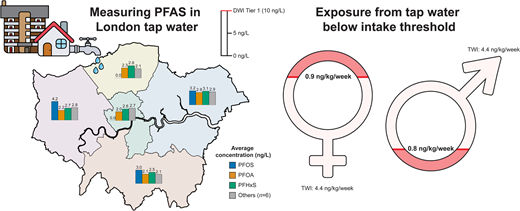
Globally, per- and poly-fluoroalkyl substances (PFAS) contamination has been reported in numerous environmental matrices, and there is a growing body of evidence that links PFAS exposure to adverse health effects. Consuming contaminated drinking water is potentially one of the most common routes of human exposure from these compounds. The spatial and temporal variability of 38 PFAS in 210 household tap water and public water fountains were assessed using a participatory sampling campaign in London, UK. The performance of commercially available water filters to remove PFAS was also assessed. Individual PFAS concentrations ranged from 0.6 ± 0.1 ng L−1 (PFBS) to 9.1 ± 0.2 ng L−1 (PFOS), and total PFAS concentrations ranged from 3 ng L−1 to 41 ng L−1 (mean = 18 ± 8 ng L−1, median = 18 ng L−1). Overall, 100% (n = 210) of all tap drinking water samples tested were within the lowest action threshold currently in place for England (<10 ng L−1 for individual PFAS), and all samples were below the threshold for total PFAS (<100 ng L−1). The daily concentration of PFAS did not substantially vary over the course of a month in three homes tested intensively. The risk to humans posed by four specific PFAS (PFOS, PFOA, PFNA, and PFHxS) in London drinking water was below the weekly tolerable intake established by the European Food Standards Authority (EFSA). Five water filters tested removed at least 85% of all PFAS studied in spiked (50 ng L−1) water samples, therefore providing an effective way to reduce concentrations in regions where such contamination is of greater concern and/or where PFAS are not routinely monitored. Our findings provide reassuring evidence about the quality of municipal drinking water in London and the UK as a whole when considering official measurements made at treatment plants. We also provide benchmark risk assessment data for the future and information to concerned citizens about the quality of tap drinking water.