2026-04-10 カリフォルニア大学リバーサイド校(UCR)
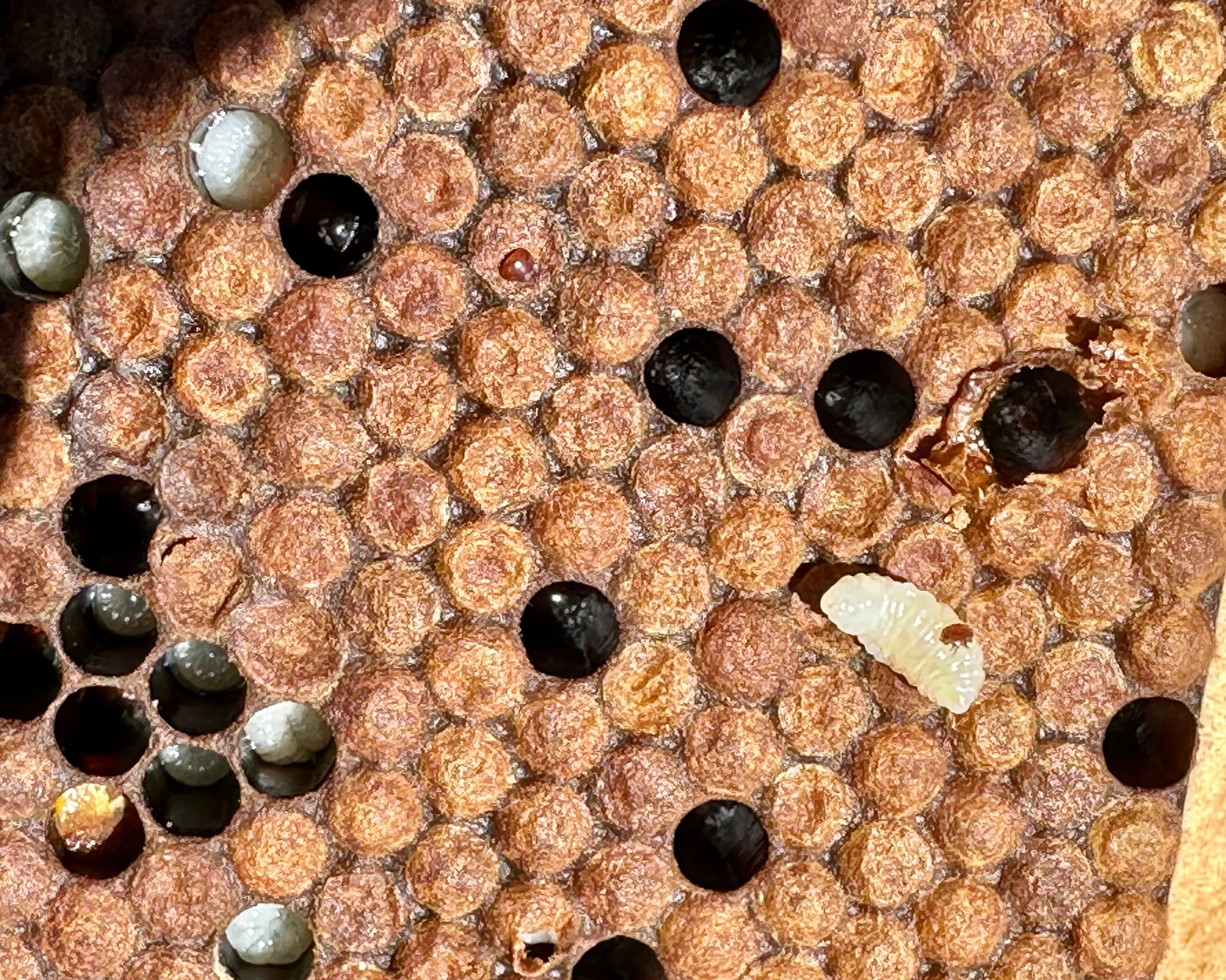
A Varroa mite on a developing honeybee larva inside a brood cell. (Genesis Chong-Echavez/UCR)
<関連情報>
- https://news.ucr.edu/articles/2026/04/10/socal-honeybees-can-fend-deadly-mites
- https://www.nature.com/articles/s41598-026-45759-9
南カリフォルニアのハイブリッドミツバチ(Apis mellifera)集団におけるミツバチヘギイタダニの抵抗性 Varroa mite resistance in a hybrid honey bee (Apis mellifera) population in Southern California
Genesis Chong-Echavez & Boris Baer
Scientific Reports Published:27 March 2026
DOI:https://doi.org/10.1038/s41598-026-45759-9
Abstract
Honey bees (Apis mellifera) are important ecological and agricultural pollinators. In the United States, beekeepers experience substantial annual colony losses, largely driven by parasites such as the mite Varroa destructor. We studied a Californian hybrid honey bee population in Southern California, a genetic mix of Western European, Eastern European, Middle Eastern, and African lineages. We predicted that these bees would show lower mite infestation levels because they survive and persist without human intervention. To test this, we monitored 236 colonies over a four-year period. We found that Californian hybrid honey bee colonies consistently had lower mite infestation rates compared to colonies headed by queens from a commercial stock. Consequently, they exceeded standard treatment thresholds (≥ 3 mites per 100 worker bees) less frequently and therefore received fewer miticide treatments. We then conducted laboratory-based-choice assays to test whether colony-level differences were reflected at the brood level. Mites were significantly less attracted to seven-day-old larvae of the Californian hybrid genotype compared to commercial larvae, indicating reduced brood attractiveness. Together, our findings indicate that this Californian hybrid population experiences lower Varroa burdens under field conditions and exhibits reduced brood attractiveness to mites under controlled laboratory conditions. This population represents a valuable resource for investigating ecological, genetic, and behavioral mechanisms underlying host resistance.