2026-03-18 中国科学院(CAS)
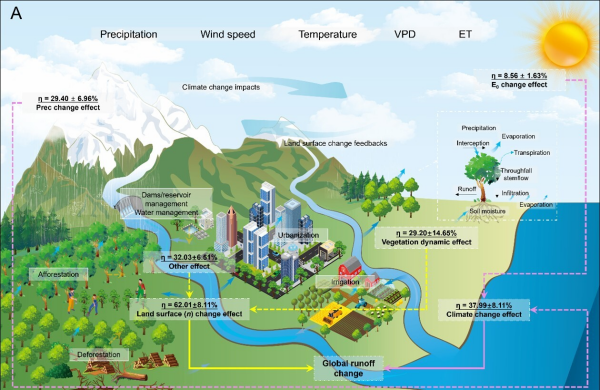
Schematic of the effects of climate change, vegetation dynamics, and other land-surface changes on global runoff variability. (Image by XIEG)
<関連情報>
- https://english.cas.cn/newsroom/research-news/202603/t20260318_1152866.shtml
- https://www.cell.com/one-earth/abstract/S2590-3322(26)00013-8
植生動態は降水が流出に及ぼす影響の約30%を相殺し、乾燥によってその影響は増幅される Vegetation dynamics offset nearly 30% of precipitation’s impact on runoff and are amplified by aridity
Yongchang Liu ∙ Zhi Li ∙ Yaning Chen ∙ … ∙ Baofu Li ∙ Gonghuan Fang ∙ Wenjing Huang
One Earth Published: February 20, 2026
DOI:https://doi.org/10.1016/j.oneear.2026.101612
Science for society
Climate change and human activities alter vegetation dynamics, affecting how plants capture rainwater (canopy interception) and release water through roots (transpiration), ultimately reshaping terrestrial runoff that is vital to global freshwater availability. As droughts grow more frequent, long-lasting, and severe, understanding vegetation responses to aridity is critical to accurately assessing water availability. This hinges on identifying aridity tipping points—thresholds where vegetation dynamics trigger abrupt runoff changes, an area still poorly understood. Using high-resolution data and systemic analysis, we reveal that vegetation offsets nearly one-third of precipitation’s effect on global runoff, exhibiting non-linear regulation tied to aridity tipping points. Our findings offer valuable guidance for policymakers to design effective and sustainable water management strategies in dryland regions.
Highlights
- We quantify global runoff responses to vegetation and aridity tipping points
- Land surface and precipitation dominated +6.83 mm global runoff during 2000–2020
- Vegetation (29.20%) offsets comparable precipitation’s contribution to runoff
- Runoff response to vegetation is more sensitive when the aridity index falls below 0.57
Summary
Global runoff is a critical resource generated by the competition between precipitation and evapotranspiration. Aridity profoundly impacts vegetation’s precipitation redistribution and evapotranspiration processes, thereby altering runoff. However, the specific aridity tipping points of these interactions remain poorly explored. Here, we quantify these distinct responses and identify their aridity tipping points using multi-source observations and modeling. We show that global total runoff increased by 6.83 mm during 2000–2020. Specifically, greening reduced runoff by 10.88 mm, while browning increased runoff by 3.16 mm; both are intensified in regions with aridity indices below 0.41 and 0.37, respectively. Through enhanced evapotranspiration, vegetation dynamics cumulatively offset 9.23 mm of the runoff increase, accounting for 29.20% of the total change and balancing precipitation’s contribution by about 29.40%. The identified aridity tipping points in vegetation’s regulation of runoff reveal non-linear responses, providing new insights for accurate water risk assessment and adaptation governance in drylands.