2026-03-09 テキサス大学オースチン校
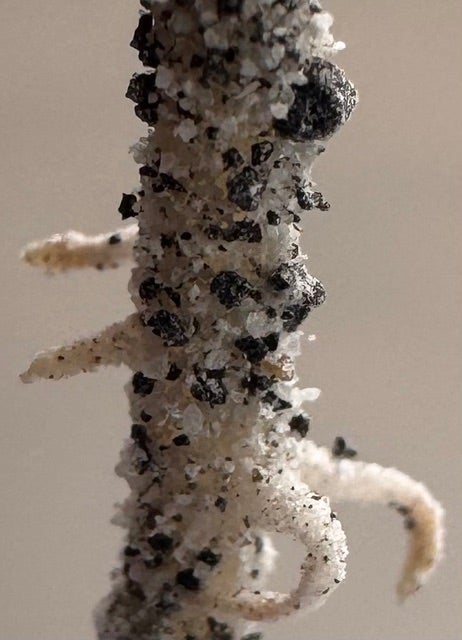
A chickpea root covered in simulated lunar soil, which is sharp and glass-like. This difficult growing environment illustrates one of the major challenges for producing crops beyond Earth. Photo by Jessica Atkin.
<関連情報>
- https://news.utexas.edu/2026/03/09/scientists-successfully-harvest-chickpeas-from-moon-dirt/
- https://www.nature.com/articles/s41598-026-35759-0
菌根菌と植物の共生による月面レゴリス模擬物のバイオレメディエーションにより、ヒヨコマメの種子形成が可能になる Bioremediation of lunar regolith simulant through mycorrhizal fungi and plant symbioses enables chickpea to seed
Jessica Atkin,Elizabeth Pierson,Terry Gentry & Sara Oliveira Santos
Scientific Reports Published:05 March 2026
DOI:https://doi.org/10.1038/s41598-026-35759-0
Abstract
Food sustainability is a significant challenge for long-term space travel. Plants can provide fresh nutrition, reducing reliance on packaged foods. Using Lunar regolith simulant (LRS), we tested a methodology to create a productive growth medium for horticultural crops on the Moon. We leveraged chickpea (Cicer arietinum), Arbuscular Mycorrhizal Fungi (AMF), and Vermicompost (VC) to enhance plant stress tolerance, sequester contaminants, and improve substrate structure. Chickpeas were cultivated in LRS/VC mixtures, with or without AMF, under climate-controlled conditions. Plants seeded successfully in mixtures containing up to 75% LRS when inoculated with AMF. While the number of seeds declined with increasing LRS concentration, seed size remained stable. Higher LRS concentrations induced stress; however, plants grown in 100% LRS inoculated with AMF demonstrated an average extension of two weeks in survival compared to non-inoculated plants. AMF colonized roots across all mixtures, including 100% LRS, demonstrating the ability to establish symbioses under extreme conditions. We also observed improvement in the structural properties of LRS by forming aggregates capable of withstanding extreme conditions, potentially mitigating particle-related hazards. These results provide a baseline for chickpea establishment and yield in amended LRS while demonstrating biological improvements in regolith properties.