2026-03-09 中国科学院(CAS)
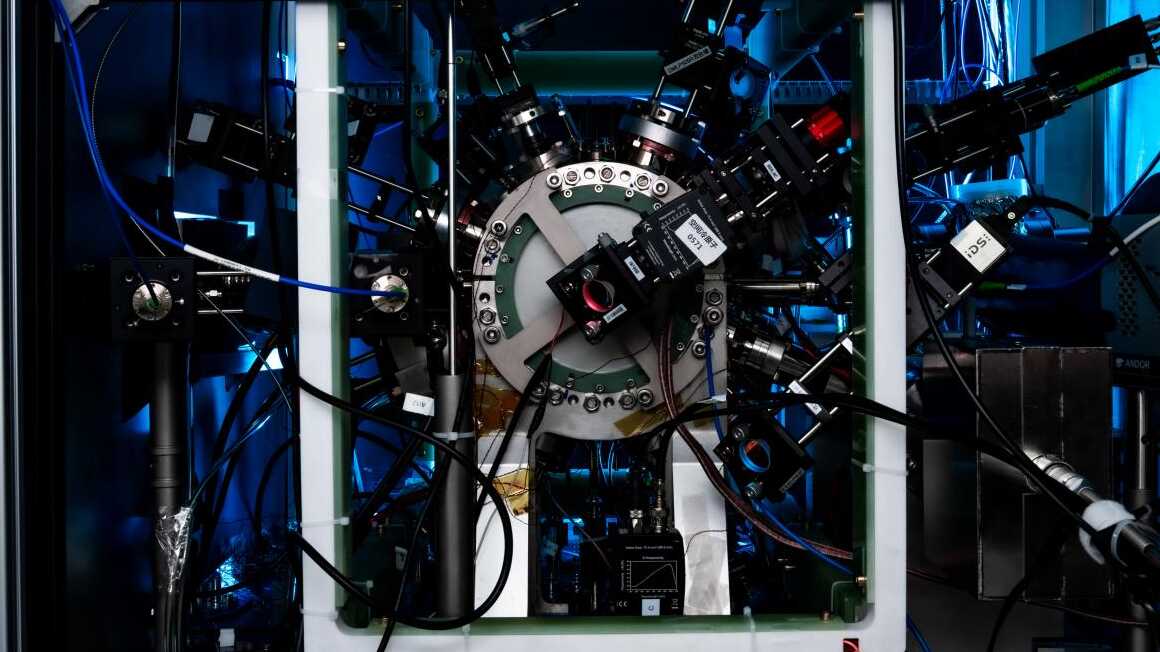
Strontium optical lattice clock developed by the University of Science and Technology of China. /via CMG
<関連情報>
- https://english.cas.cn/newsroom/cas-in-media/202603/t20260309_1152046.shtml
- https://iopscience.iop.org/article/10.1088/1681-7575/ae449e
不確かさが以下のストロンチウム光時計の体系的な評価の改善1×10-18 Improved systematic evaluation of a strontium optical clock with uncertainty below 1×10-18
Zhi-Peng Jia, Jie Li, De-Quan Kong, Xiang Zhang, Hai-Wei Yu, Xiao-Yong Liu, Yu-Chen Zhang, Yuan-Bo Wang, Xian-Qing Zhu, Jia-Hao Zhang,…
Metrologia Published: 5 March 2026
DOI:10.1088/1681-7575/ae449e
Abstract
We report a systematic uncertainty of 9.2 × 10⁻¹⁹ for the Sr1 optical lattice clock at the University of Science and Technology of China (USTC), achieving accuracy at the level required for the roadmap of the redefinition of the SI second. A finite-element model with in situ-validated, spatially-resolved chamber emissivity reduced blackbody radiation (BBR) shift uncertainty to 6.3 × 10⁻¹⁹. Concurrently, the externally mounted lattice cavity, by providing a larger beam waist, reduced the atomic density and thereby suppressed the density shift. Enhanced lattice depth modulation consolidated lattice light shift uncertainty to 6.3 × 10⁻¹⁹ by enabling simultaneous determination of key polarizabilities and magic wavelength. Magnetic shifts were resolved below 10−18 via precision characterization of the second-order Zeeman coefficient. Supported by a clock laser stabilized on an ultralow-expansion glass cavity with crystalline-coated mirrors and refined temperature control suppressing BBR fluctuations, the clock also achieves a frequency stability better than 1 × 10⁻¹⁸ at 30 000 s averaging time. These developments collectively establish a new benchmark in USTC Sr1 clock performance and pave the way for high-accuracy applications in metrology and fundamental physics.