2026-02-03 中国科学院(CAS)
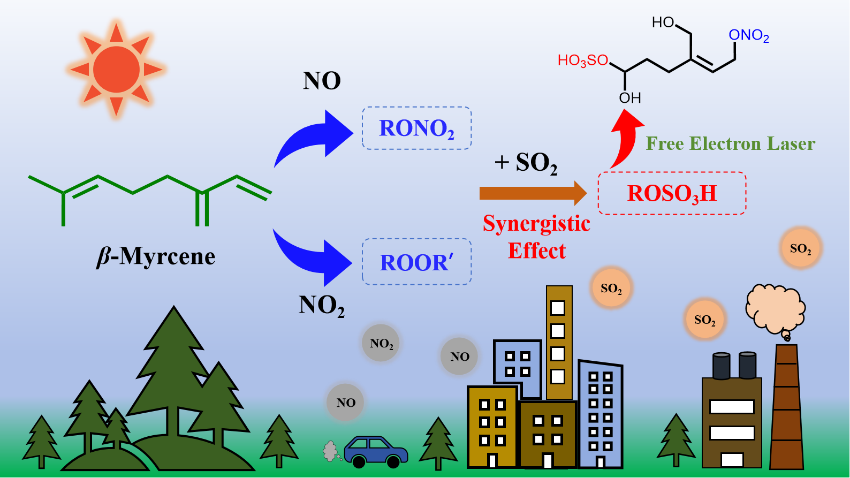
Schematic illustration of the synergistic effects of NOx and SO2 on β-myrcene photooxidation (Image by ZHAO Ya)
<関連情報>
- https://english.cas.cn/newsroom/research-news/202603/t20260306_1151868.shtml
- https://pubs.acs.org/doi/full/10.1021/acs.est.5c10374
Distinct Roles of NO2 versus NO and Synergisms with SO2 in Secondary Organic Aerosol Formation from β-Myrcene Photooxidation
Ya Zhao,Chong Wang,Yingqi Zhao,Yufeng Shao,Hua Xie,Jiayue Yang,Weiqing Zhang,Guorong Wu,Gang Li,Ling Jiang,and Xueming Yang
Environmental Science & Technology Published: February 1, 2026
DOI:https://doi.org/10.1021/acs.est.5c10374
Abstract
Elucidating the impacts of gaseous pollutants on secondary organic aerosol (SOA) formation mechanisms is critical for developing effective PM2.5 mitigation strategies. However, the combined effects of NOx (NOx = NO2 + NO) and SO2 on SOA compositions under complex photochemical conditions remain mechanistically unresolved. Here, we investigated the individual roles of NO2/NO and their combined effects with SO2 on β-myrcene photooxidation. Our results showed that NO2 enhanced the SOA yield and the O:C ratio through oxidant amplification, whereas NO suppressed nucleation and oxidation states of products but facilitated particle size growth via organic nitrate partitioning. SO2 exhibited significant synergistic effects with both NO2 and NO, facilitating particle formation and growth processes. The newly built vacuum ultraviolet free electron laser photoionization aerosol mass spectrometer enabled the observation of a series of new compounds (i.e., organic peroxides, organic nitrate, and organosulfates) and identified new mechanisms of SOA formation. Notably, a novel compound with a molecular weight of 287 was characterized to be a nitrogen- and sulfur-containing species. These findings highlight the critical roles of pollutants in particle formation in environmental processes and provide key scientific support for regional air quality management and climate change mitigation.