
2026-03-05 ペンシルベニア州立大学(Penn State)
<関連情報>
- https://www.psu.edu/news/research/story/making-mini-lightning-block-plastic
- https://journals.aps.org/prl/abstract/10.1103/4p6l-rzck
- https://www.science.org/doi/10.1126/science.ado5943
- https://tiisys.com/blog/2025/07/29/post-172478/
- https://journals.aps.org/pre/abstract/10.1103/m62y-7lf8
誘電体固体における相対論的フィードバック放電 Relativistic Feedback Discharges in Dielectric Solids
Victor P. Pasko, Sebastien Celestin, and Anne Bourdon
Physical Review Letters Published: 5 March, 2026
DOI: https://doi.org/10.1103/4p6l-rzck
Abstract
The photoelectric feedback processes leading to growth of relativistic runaway electron avalanches are believed to be responsible for extreme fluxes of rays produced from very compact regions of space with dimensions on the order of a hundred meters in association with lightning activity in the Earth’s natural environment [V. P. Pasko et al., Photoelectric effect in air explains lightning initiation and terrestrial ray flashes, J. Geophys. Res. 130, e2025JD043897 (2025)]. Here, we demonstrate for the first time that the same photoelectric feedback discharges can be realized on centimeter scales in common solid state dielectric materials, like quartz, acrylic, and bismuth germanate. These discharges can serve as new sources of high energy x-ray radiation.
電子照射を受けたポリメチルメタクリレートにおける高速電気トリー成長のダイナミクス Dynamics of high-speed electrical tree growth in electron-irradiated polymethyl methacrylate
Kathryn M. Sturge、 Noah Hoppis、 Ariana M. Bussio、 Jonathan Barney、 […]、 Timothy W. Koeth
Science Published:18 Jul 2024
DOI:https://doi.org/10.1126/science.ado5943
Editor’s summary
Dielectric materials are important for a number of applications and can accumulate enough charge to discharge catastrophically. Although the shape of these electrical tree discharges have been studied previously, Sturge et al. have found a new kind of discharge, an ivy type, that has not been described before. The discharge speed is very high, and understanding how it forms is key to designing materials that are less susceptible to electrostatic discharge failure. —Brent Grocholski
Abstract
Dielectric materials are foundational to our modern-day communications, defense, and commerce needs. Although dielectric breakdown is a primary cause of failure of these systems, we do not fully understand this process. We analyzed the dielectric breakdown channel propagation dynamics of two distinct types of electrical trees. One type of these electrical trees has not been formally classified. We observed the propagation speed of this electrical tree type to exceed 10 million meters per second. These results identify substantial gaps in the understanding of dielectric breakdown, and filling these gaps is paramount to the design and engineering of dielectric materials that are less susceptible to electrostatic discharge failure.
自然雲内コンパクト放電の代理として電子荷電ポリメチルメタクリレート中の静電放電電流の特性評価 Characterization of electrostatic discharge currents in electron-charged polymethyl methacrylate as a proxy for natural compact intracloud discharges
Kathryn M. Sturge, Noah Hoppis, Brian L. Beaudoin, Ariana M. Shearin, Ethan T. Basinger, Bryson C. Clifford, Jack R. FitzGibbon, Emily H. Frashure, James E. Krutzler et al.
Physical Review E Published: 13 June, 2025
DOI: https://doi.org/10.1103/m62y-7lf8
Abstract
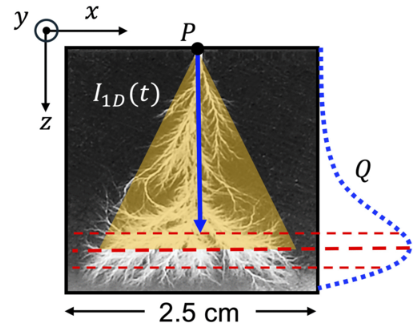
Electrostatic discharges occur in numerous media on a range of length scales, from microscopic discharges inside electronic materials to kilometer-long channels in air during natural lightning events. To study the mechanisms and behavior of electrostatic discharges inside materials, we measured the discharge currents produced during dielectric breakdown of electron-charged polymethyl methacrylate. The resulting current waveforms were analyzed and the relevant parameters for characterizing the waveform morphology were extracted and investigated to build a functional model to describe and characterize the waveforms from these types of discharges. The model involves a distinction between one-dimensional and two-dimensional discharge channel growth, which are governed by separate principles and thus have different contributions to the total measured discharge current. We show that this model, which is derived from the discharge channel growth during the event, allows us to infer characteristics about the dynamics of the breakdown, such as the instantaneous velocity of the channels during breakdown. We applied this model to the context of natural compact intracloud discharges, or narrow bipolar events, by scaling the one-dimensional waveforms in size and time to those relevant to compact intracloud discharges. We find that the discharge currents derived from centimeter-scale and submicrosecond-duration electrostatic discharge events in electron-irradiated polymethyl methacrylate obey the same functional form of those of natural compact intracloud discharges, leading to the conclusion that the polymethyl methacrylate– (PMMA) based discharges may a useful laboratory tool to reproduce narrow bipolar events discharge currents. We calculated the electric field that would be radiated by these scaled discharge currents using published measurement parameters for compact intracloud discharges and found that the magnitude and pulse shape agree with observations very well. In addition, we find that energy spectral density of the scaled PMMA discharge waveforms have a similar frequency dependence in the 3- to 300-MHz band to those of compact intracloud discharges. These results support the idea that space charge in and around thunderclouds may be the driving mechanism of compact intracloud discharges and that electron-irradiated solid dielectrics may be a useful laboratory-based analog to study natural lightning events.

